









-
 Unlimited Activations
-
 Instant delivery
-
 Easy to install







 Unlimited Activations
Instant delivery
Easy to install
Unlimited Activations
Instant delivery
Easy to install
 Free Update
 Free Install Support

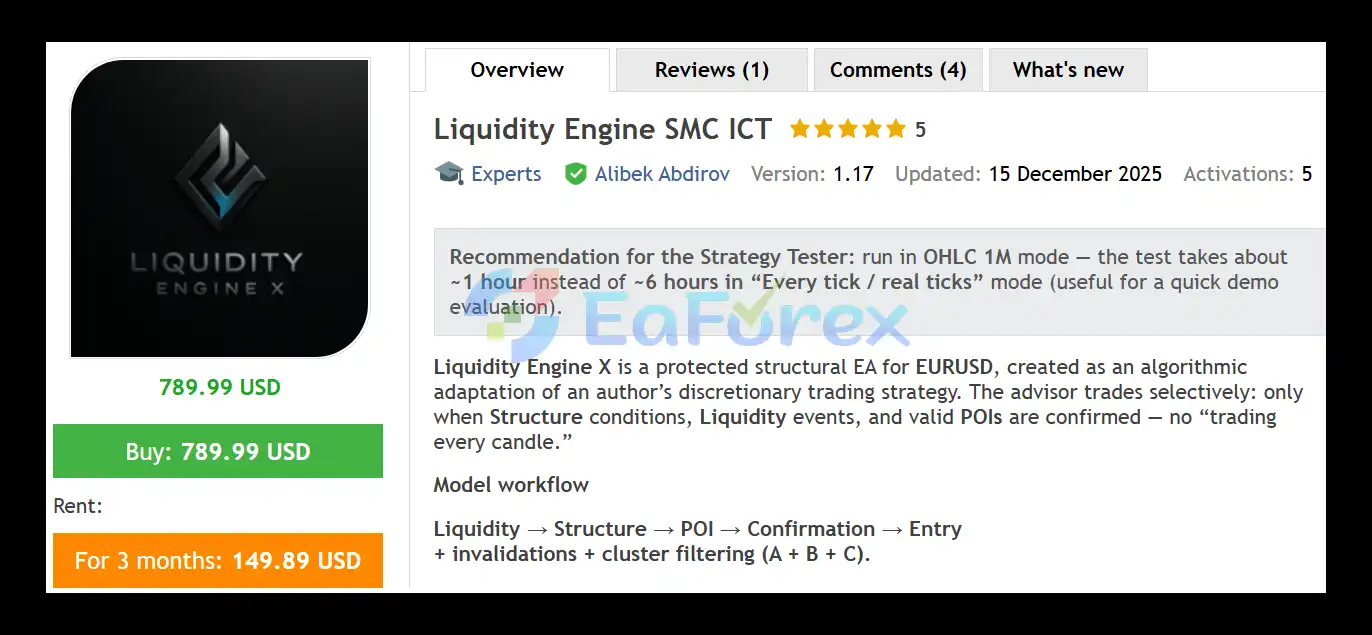
Liquidity Engine SMC ICT MT5 is a specialized Expert Advisor for EURUSD, developed as an algorithmic adaptation of a discretionary trading strategy based on Smart Money Concepts (SMC), liquidity, market structure, and Points of Interest (POIs).
Unlike automated systems designed to trade frequently, Liquidity Engine SMC ICT MT5 follows a selective trading approach. The EA does not attempt to trade every candle or every market movement. Instead, it waits for multiple conditions to align before considering an entry.
The core model follows a structured workflow:
Liquidity → Structure → POI → Confirmation → Entry
Additional invalidation rules and cluster filtering based on A + B + C conditions are used to help eliminate weaker trading scenarios.
Liquidity Engine is designed as a fully automated, black-box trading system with minimal configuration. It does not require visual indicators or complicated manual adjustments, with risk per trade serving as the primary user-controlled parameter.
The EA does not use Martingale, Grid, or Averaging strategies, making its approach fundamentally different from recovery-based trading systems.
>> Delivery time 24h-48h after payment.
>>> Refund if not delivered.
>>> You will receive the latest version without any limitations (ID+Time).>>Reviewed by Jason Stap <<
Liquidity Engine SMC ICT MT5 is specifically designed for EURUSD, allowing the algorithm to focus on the market structure, liquidity behavior, and price-action characteristics of the currency pair.
The strategy is based on structural concepts commonly associated with SMC and ICT-style trading, including liquidity events, market structure, Points of Interest, confirmations, and invalidation conditions.
The system converts these discretionary concepts into an automated algorithmic workflow.
The EA is designed to prioritize trade quality over trade frequency.
Rather than opening positions on every candle, Liquidity Engine waits for the required combination of:
Only when the required conditions align does the algorithm consider an entry.
Liquidity Engine operates automatically without requiring traders to manually analyze charts or execute individual trades.
The system works as a black-box EA, meaning its internal trading logic is automated rather than dependent on visual indicators displayed for manual decision-making.
The strategy does not use:
This is an important characteristic for traders who prefer a selective structural strategy rather than recovery-based position management.
Liquidity Engine is designed with a simple configuration approach.
The main user-controlled parameter is risk per trade, allowing traders to focus on choosing an appropriate risk level rather than adjusting a large number of technical strategy parameters.
The EA can be used on both real trading accounts and prop firm accounts, provided that the selected risk profile and configuration are compatible with the account’s rules.
Traders should always verify the individual requirements of their broker or prop firm before deploying the EA.
Although the strategy focuses its activity on the liquid trading window of approximately 09:00–18:00 UTC+3, the EA should remain active 24/5 so it can continuously monitor structural transitions.
A reliable VPS is recommended for uninterrupted operation.
Liquidity Engine follows a multi-stage structural workflow rather than generating entries from a single indicator.
The core process is:
Liquidity → Structure → POI → Confirmation → Entry
The algorithm first evaluates relevant liquidity conditions in the market.
Liquidity events can provide important context for determining whether a potential trading scenario is developing.
After evaluating liquidity, the system analyzes market structure to determine whether the current price action satisfies the required structural conditions.
The algorithm then looks for a valid Point of Interest (POI) that fits the strategy’s structural framework.
A potential setup must receive the required confirmation before the system considers entering a position.
Additional A + B + C cluster filtering is applied to help remove weaker or incomplete scenarios.
Only after the required conditions align does the EA execute a trade.
This selective workflow is designed to reduce unnecessary entries and maintain the strategy’s focus on high-quality structural setups.
Liquidity Engine SMC ICT MT5 is designed for traders who prefer a selective, structure-based approach to automated EURUSD trading.
One of its main characteristics is its emphasis on trade quality rather than trade quantity. With approximately 3–4 trades per month in the stated historical profile, the EA is not designed to remain constantly active in the market.
The system also avoids common recovery mechanisms such as Martingale, Grid, and Averaging. Instead, the strategy focuses on identifying specific combinations of liquidity, structure, POI, confirmation, and cluster conditions.
Another advantage is its simple configuration. Rather than requiring traders to manually optimize numerous strategy parameters, the primary setting is risk per trade.
For traders familiar with SMC and ICT-style market concepts who want an automated implementation for EURUSD, Liquidity Engine provides a structured black-box approach to algorithmic trading.
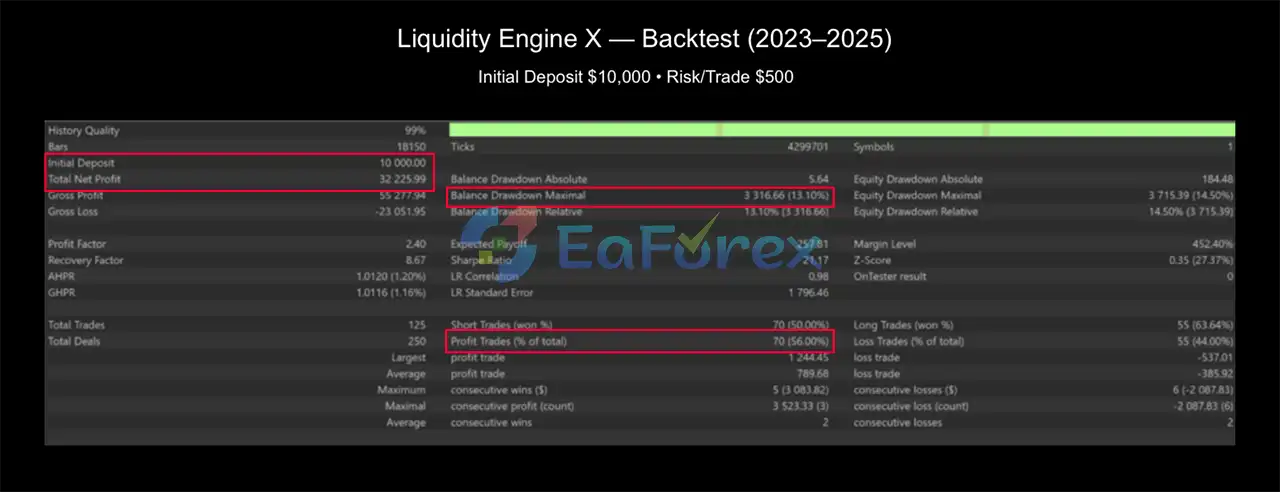
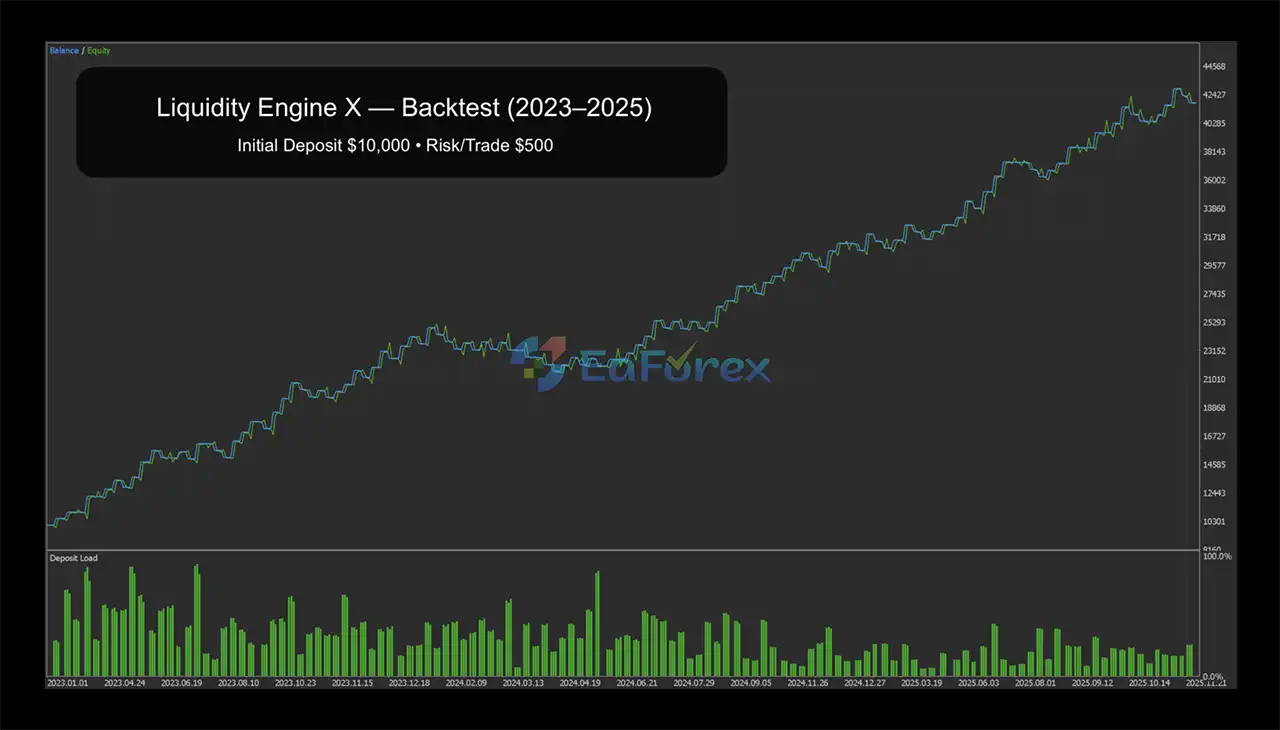
🔺EURUSD pair – 2 years – Risk/Trade strategy: $500
Liquidity Engine SMC ICT EA Backtest
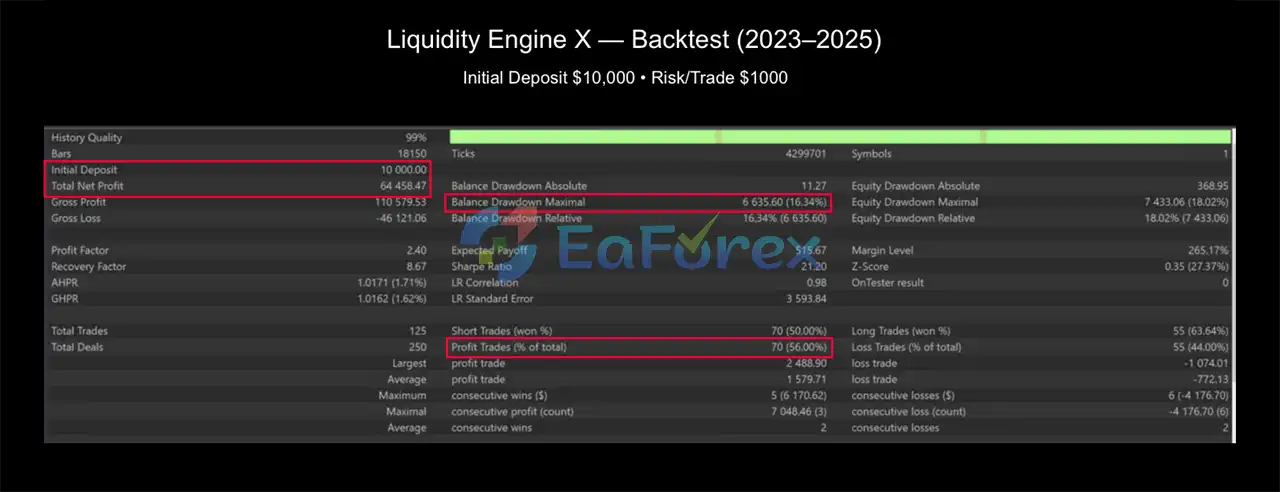
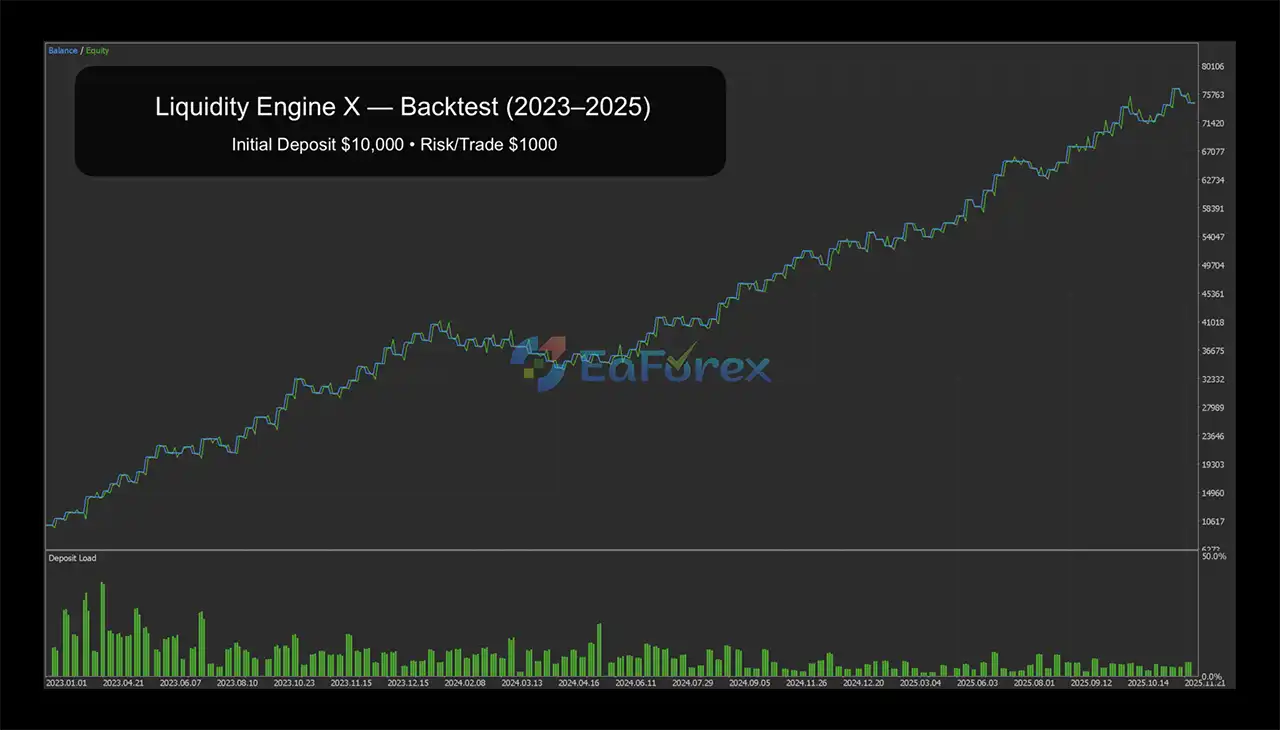
🔺EURUSD pair – 2 years – Risk/Trade strategy: $1.000
Liquidity Engine SMC ICT EA Backtests
The stated historical profile covers approximately 2023–2025 and includes the following approximate characteristics:
These figures should be treated as an approximate historical profile rather than a guarantee of future performance.
One of the important characteristics of Liquidity Engine is that performance should not be evaluated solely by its win rate.
If risk per trade is represented as 1R, then a trade producing 2R means the profit is approximately twice the amount initially risked.
Because individual winning trades may typically generate around 1R–2.5R, the overall performance profile depends on the relationship between:
This makes R-multiple performance an important metric when evaluating the EA.
The supplied strategy recommends thinking of the trading capital as approximately 10–20 conditional trades.
Traders should select a risk-per-trade level based on:
For more aggressive risk profiles, sufficient leverage and a healthy margin buffer may be necessary to ensure positions can be executed correctly, depending on position size and stop-loss distance.
Liquidity Engine’s selective approach also means that it may not suit traders looking for frequent daily trading activity.
The historical profile indicates approximately 3–4 trades per month. This means the EA may remain inactive for extended periods while waiting for qualifying market conditions.
The historical profile indicates that the system may experience up to approximately six consecutive losses.
Traders should therefore avoid selecting a risk-per-trade level that is too aggressive for their account.
The 2023–2025 historical profile provides information about previous market behavior, but it does not guarantee future performance.
Market structure, liquidity conditions, volatility, and trading environments can change over time.
Although EURUSD is one of the most liquid currency pairs, its behavior can change around central-bank decisions, economic releases, geopolitical events, and shifts in market sentiment.
Because the primary user-controlled setting is risk per trade, selecting an inappropriate risk level can significantly affect drawdown and account survival.
Aggressive risk settings may require sufficient leverage and margin. Traders should ensure their account can support the intended position sizes without creating excessive margin pressure.
The EA should remain active 24/5 to monitor structural transitions, even though its primary trading window is approximately 09:00–18:00 UTC+3.
A reliable VPS is therefore recommended.
Always test the EA in the MetaTrader 5 Strategy Tester and on a demo account before using real capital.
Install MetaTrader 5 through your broker and log in to your trading account.
In MetaTrader 5, select:
File → Open Data Folder
Then navigate to:
MQL5 → Experts
Copy the Liquidity Engine SMC ICT MT5 EA file into the Experts folder.
Restart MetaTrader 5 or refresh the Expert Advisors section in the Navigator window.
Open the EURUSD chart in MetaTrader 5.
Use the timeframe recommended by the EA’s current configuration or product documentation.
Open:
Navigator → Expert Advisors
Find Liquidity Engine SMC ICT MT5 and drag it onto the EURUSD chart.
The primary setting is risk per trade.
Choose a risk level that is appropriate for your account size, historical drawdown tolerance, and trading objectives.
Avoid using an aggressive risk profile without first evaluating the EA through the Strategy Tester and demo trading.
Make sure Algo Trading is enabled in MetaTrader 5 and that the EA has permission to trade.
Keep MetaTrader 5 running on a reliable VPS 24/5 so that the EA can continuously monitor market structure and liquidity transitions.
Always perform adequate demo testing before deploying the EA on a live account.
🔺Liquidity Engine SMC ICT EA is highly appreciated by the MQL5 community for bringing stable and reliable profits. Below are 5 star reviews from users:
>>> Join VIP Membership Now <<<
Liquidity Engine SMC ICT MT5 is a specialized EURUSD Expert Advisor that brings a selective structural trading methodology into an automated MetaTrader 5 environment.
Its core philosophy is simple:
Liquidity → Structure → POI → Confirmation → Entry
Instead of attempting to trade continuously, the EA waits for specific structural and liquidity conditions to align before entering the market. The additional invalidation rules and A + B + C cluster filtering are designed to help eliminate weaker scenarios.
The system also avoids Martingale, Grid, and Averaging, while keeping configuration relatively simple with risk per trade as the primary user-controlled parameter.
The stated historical profile of approximately 55% win rate, 3–4 trades per month, up to six consecutive losses, and around 20R per year highlights why the strategy should be evaluated using its complete R-multiple profile rather than win rate alone.
For traders looking for an automated SMC/ICT-inspired EURUSD trading system with selective execution and structured risk management, Liquidity Engine SMC ICT MT5 offers a distinctive approach.
However, traders should remember that historical performance is not a guarantee of future results. Proper risk management, Strategy Tester analysis, demo testing, sufficient margin, and reliable VPS operation are essential considerations before using the EA with real trading capital.
1. What is Liquidity Engine SMC ICT MT5?
Liquidity Engine SMC ICT MT5 is a structure-based automated trading Expert Advisor designed exclusively for EURUSD. It algorithmically applies Smart Money Concepts (SMC) and ICT trading logic, focusing on liquidity events, market structure shifts, and validated Points of Interest (POIs).
2. How does Liquidity Engine SMC ICT MT5 trade the market?
The EA follows a structured workflow:
Liquidity → Market Structure → POI → Confirmation → Entry.
Trades are executed only when all conditions align, ensuring high-quality, rule-based entries.
3. Does Liquidity Engine SMC ICT MT5 use Martingale or Grid strategies?
No. This EA completely avoids martingale, grid, averaging, or recovery techniques. Risk is strictly controlled on a per-trade basis.
4. What makes Liquidity Engine SMC ICT MT5 different from other EAs?
Unlike high-frequency systems, this EA prioritizes trade quality over quantity, averaging only 3–4 trades per month, and focuses on R-multiple profitability rather than win-rate manipulation.
5. Which trading pair does Liquidity Engine SMC ICT MT5 support?
The EA is exclusively optimized for EURUSD, ensuring precise adaptation to the pair’s liquidity behavior and structure patterns.
6. Is Liquidity Engine SMC ICT MT5 suitable for prop firm accounts?
Yes. The EA is prop-firm compatible, designed to respect strict drawdown rules, controlled risk exposure, and disciplined execution standards.
7. What is the risk management philosophy of Liquidity Engine SMC ICT MT5?
The EA emphasizes:
Fixed risk per trade
Capital segmentation (10–20 conditional risk units)
Controlled loss sequences (up to ~6 consecutive losses within tolerance)
This approach ensures long-term equity stability.
8. When does Liquidity Engine SMC ICT MT5 trade?
The EA is optimized for the high-liquidity session between 09:00–18:00 UTC+3, while continuously monitoring the market 24/5 to detect structural changes.
9. Is Liquidity Engine SMC ICT MT5 fully automated?
Yes. It is a black-box autonomous system that runs without visual indicators or manual intervention. Continuous operation via VPS is recommended.
10. Who is Liquidity Engine SMC ICT MT5 best suited for?
This EA is ideal for disciplined and serious traders who value consistency, structure-based trading, and controlled risk, rather than aggressive or hype-driven strategies.
In stock
In stock
In stock
In stock
In stock
Out of stock
No account yet?
Create an Account












 Automatic EA
 EA Best Seller
 Expert Advisor MT4
 Expert Advisor MT5
 HFT EA


Reviews
Clear filtersThere are no reviews yet.