
Product Overview
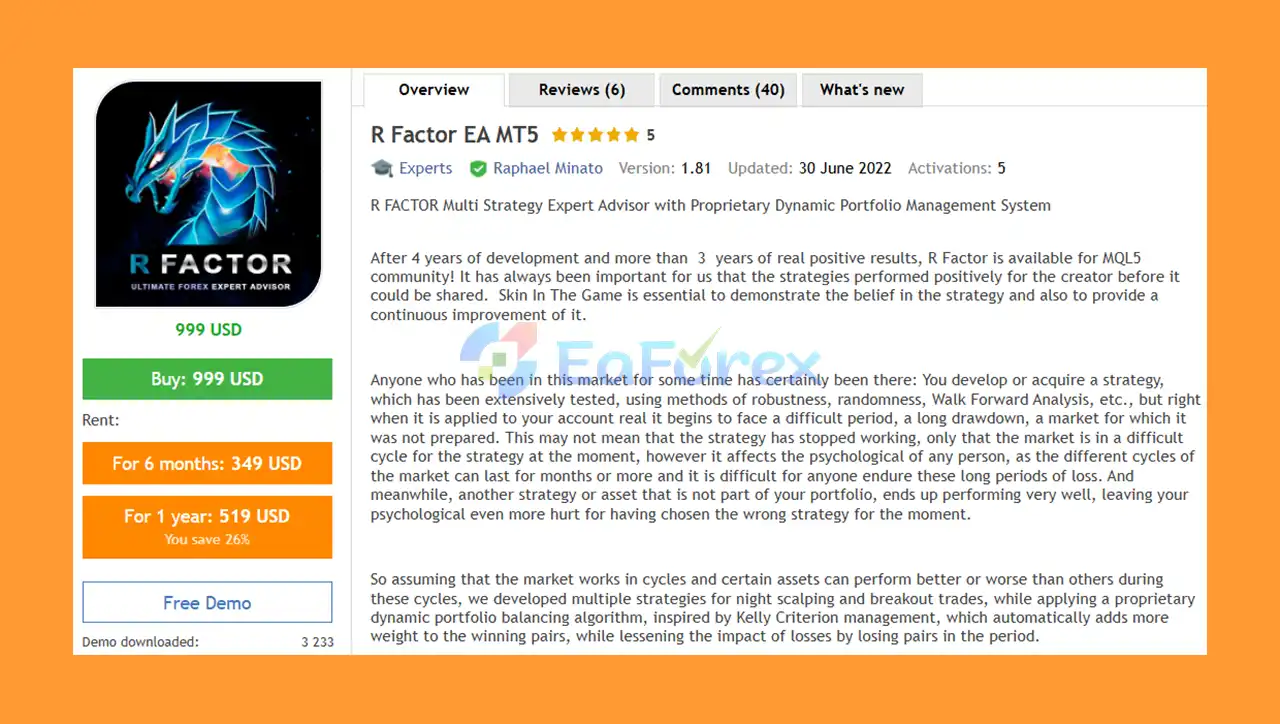
R Factor EA MT5 is a multi-strategy Expert Advisor designed for MetaTrader 5, combining night scalping, breakout trading, and a proprietary dynamic portfolio management system. Developed over four years, the EA was created to address one of the biggest challenges in automated trading: adapting a portfolio to changing market cycles.
Financial markets constantly evolve, and different currency pairs can perform differently depending on volatility, market direction, liquidity, and trading sessions. A strategy that performs well during one period may experience extended drawdowns when market conditions change. R Factor EA MT5 addresses this challenge by combining multiple trading strategies with an adaptive portfolio-balancing algorithm inspired by the Kelly Criterion.
Instead of allocating equal importance to every trading pair, the R Factor algorithm dynamically adjusts the relative weight of individual pairs according to their performance. Winning pairs can receive greater portfolio weight, while underperforming pairs can have their contribution reduced. This approach aims to improve portfolio adaptability and distribute trading responsibility according to changing performance.
R Factor EA MT5 also incorporates defined Stop Loss levels, dynamic Take Profit, an intelligent trade exit system, a news filter, and proprietary backtest simulations designed to evaluate performance during periods of elevated spreads.
Importantly, the EA follows a non-averaging, non-Martingale approach. It allows only one open trade per pair at a time, helping distinguish its trading structure from recovery systems that increase position counts to manage losing trades.
With its multi-strategy architecture and dynamic portfolio allocation, R Factor EA MT5 is designed for traders seeking an automated Forex portfolio that can adapt to different market conditions rather than relying on a single strategy or currency pair.
About the Developer
• Author: Raphael Minato
• Experience: Over 1 years of experience on MQL5.
• Notable Products: R Factor EA MT5, R Factor EA MT4 and other advisors.
• Flagship Product: PrimAI Power MT5 is rated as the best performing product of the year.
>> Delivery time 24h-48h after payment.
>>> Refund if not delivered.
>>> You will receive the latest version without any limitations (ID+Time).>>Reviewed by Jason Stap <<
Key Features of R Factor EA MT5
Multi-Strategy Trading System
R Factor EA MT5 combines multiple trading approaches to take advantage of different market environments.
Its principal strategy categories include:
- Night Scalping: Targets short-term trading opportunities during selected nighttime market sessions.
- Breakout Trading: Seeks opportunities when price moves beyond established market levels.
- Multi-Strategy Portfolio: Combines different strategy configurations and currency pairs to diversify trading opportunities.
Using multiple approaches can help reduce dependence on a single market behavior, although diversification does not eliminate trading risk.
Proprietary Dynamic Portfolio Management
One of the defining characteristics of R Factor EA MT5 is its proprietary dynamic portfolio-balancing algorithm.
Inspired by the Kelly Criterion, the system adjusts the relative importance of different trading pairs according to their performance.
Key objectives include:
- Increasing the portfolio weight of stronger-performing pairs.
- Reducing the contribution of underperforming pairs.
- Adapting capital allocation as performance changes.
- Allowing successful strategies to contribute more significantly to portfolio results.
This approach is designed to help the portfolio respond to changing market cycles. However, increasing the weight of winning pairs can also increase portfolio volatility and exposure to performance reversals.
One-Chart Setup
R Factor EA MT5 supports a one-chart setup for managing its configured portfolio.
This simplifies the installation process and reduces the need to attach separate Expert Advisors to multiple charts manually.
The exact symbols and strategy configurations must still be enabled through the appropriate settings or recommended configuration sets.
Defined Stop Loss and Dynamic Take Profit
Every trade uses a defined Stop Loss and a dynamic Take Profit mechanism.
- Stop Loss establishes a predefined exit level for risk control.
- Dynamic Take Profit allows the profit target to adapt according to the strategy's programmed logic.
- Intelligent trade exits help manage open positions throughout their lifecycle.
These mechanisms are intended to structure trade management, but they cannot guarantee that every position will close at its requested price during gaps or poor execution conditions.
One Trade Per Pair
R Factor EA MT5 allows only one open trade per currency pair at a time.
The system does not use averaging or Martingale strategies, avoiding recovery methods that repeatedly add positions to a losing trade or systematically increase lot sizes to recover previous losses.
This structure can make exposure easier to evaluate, although individual trades and concentrated portfolio positions can still generate substantial losses.
Intelligent Trade Exit System
The EA incorporates a dedicated trade-exit system to manage positions according to the strategy's internal conditions.
Combined with Stop Loss and dynamic Take Profit, this feature is designed to help the EA respond to changing market conditions without requiring constant manual intervention.
Integrated News Filter
The built-in news filter is designed to help manage exposure around selected economic announcements.
This can be particularly relevant for night scalping and breakout strategies, where sudden volatility, spread expansion, and rapid price changes may affect execution.
The effectiveness of the filter depends on its configuration and the accuracy of the underlying economic calendar.
High-Spread Backtest Simulation
R Factor EA MT5 includes a proprietary backtest simulation intended to evaluate strategy behavior during periods of elevated spreads.
This is relevant because night scalping strategies can be sensitive to transaction costs, and results obtained under ideal spread conditions may not reflect real trading performance.
Historical Live-Performance Track Record
According to the developer, the EA was developed over four years and has delivered more than three years of positive real-account results for certain strategies and configurations.
These claims relate to the developer's reported historical experience and should be evaluated using independently verifiable account records, drawdown statistics, and trading conditions.
Past performance does not guarantee future profitability.
Customer Support and Exclusive Telegram Group
Customers who purchase the full version can request access to the exclusive R Factor Telegram group by contacting the developer and providing proof of purchase.
The group provides updates about new developments, strategies, and configuration sets.
The developer also offers recommended R Factor sets and currency-pair configurations upon request after proof of purchase or rental.
How Does R Factor EA MT5 Work?
R Factor EA MT5 operates by combining individual trading strategies with a portfolio-level allocation mechanism.
Rather than relying exclusively on one currency pair or one type of market entry, the EA is designed to manage several strategy and pair combinations through a unified portfolio.
Step 1: Select Trading Strategies
The EA uses configured night scalping and breakout strategies to identify trading opportunities.
The actual strategy selection depends on the enabled configuration sets.
Step 2: Identify Entry Opportunities
Each enabled strategy evaluates its programmed trading conditions and determines whether a valid entry opportunity is available.
When the conditions are satisfied, the EA opens a position according to its trading logic.
Step 3: Apply Trade-Level Risk Management
After entering a trade, the EA uses a defined Stop Loss and dynamic Take Profit, together with its intelligent exit system.
Only one open trade per pair is permitted at a time.
Step 4: Monitor Strategy Performance
The portfolio management algorithm evaluates the relative performance of the configured trading pairs or strategies.
Step 5: Adjust Portfolio Weights
Based on the algorithm's allocation rules, stronger-performing pairs can receive more weight, while weaker-performing pairs can have their relative contribution reduced.
This dynamic allocation is intended to help the portfolio adapt as market conditions and strategy performance change.
Step 6: Continue Portfolio Rebalancing
As performance evolves, the system can adjust the relative importance of the different pairs.
The goal is to allow stronger-performing components to contribute more to portfolio results while limiting the impact of weaker-performing components.
However, this process does not guarantee that winning pairs will continue to outperform or that reduced-weight pairs will recover.
Important: R Factor EA MT5 requires the correct strategy configuration sets to function as intended. The developer states that the default settings have no strategies enabled, so the EA will not trade properly until the appropriate configurations are installed and activated.
Why Choose R Factor EA MT5?
Multiple Trading Strategies
Combining night scalping and breakout strategies gives traders access to different types of market opportunities within one automated framework.
Dynamic Portfolio Allocation
The proprietary balancing algorithm is designed to adapt portfolio weights to changing pair performance rather than maintaining a permanently equal allocation.
No Averaging or Martingale
The EA does not use averaging or Martingale strategies and limits trading to one open position per pair.
This avoids certain forms of escalating exposure associated with recovery-based trading systems.
Structured Trade Management
Defined Stop Loss, dynamic Take Profit, an intelligent exit system, and a news filter provide a structured approach to automated trade management.
One-Chart Operation
The one-chart setup simplifies portfolio management and reduces the need for manual multi-chart installation.
Focus on Realistic Trading Conditions
The proprietary high-spread backtest simulation is designed to examine how strategies may behave when transaction costs increase.
Flexible Portfolio Configuration
Different strategy sets and recommended currency pairs allow traders to configure the system according to their selected portfolio.
Developer Updates and Community Support
Full-version customers can request access to the exclusive Telegram group for strategy updates, configuration sets, and further development information.
Accessible Starting Capital
The developer states that the suggested starting capital can be as low as:
- $30 for one currency pair
- $100 for a complete 12-pair portfolio
These amounts are developer-provided minimum guidelines, not assurances of adequate risk capacity. Actual capital requirements depend on lot sizing, leverage, broker conditions, trading costs, and the maximum drawdown a trader can tolerate.
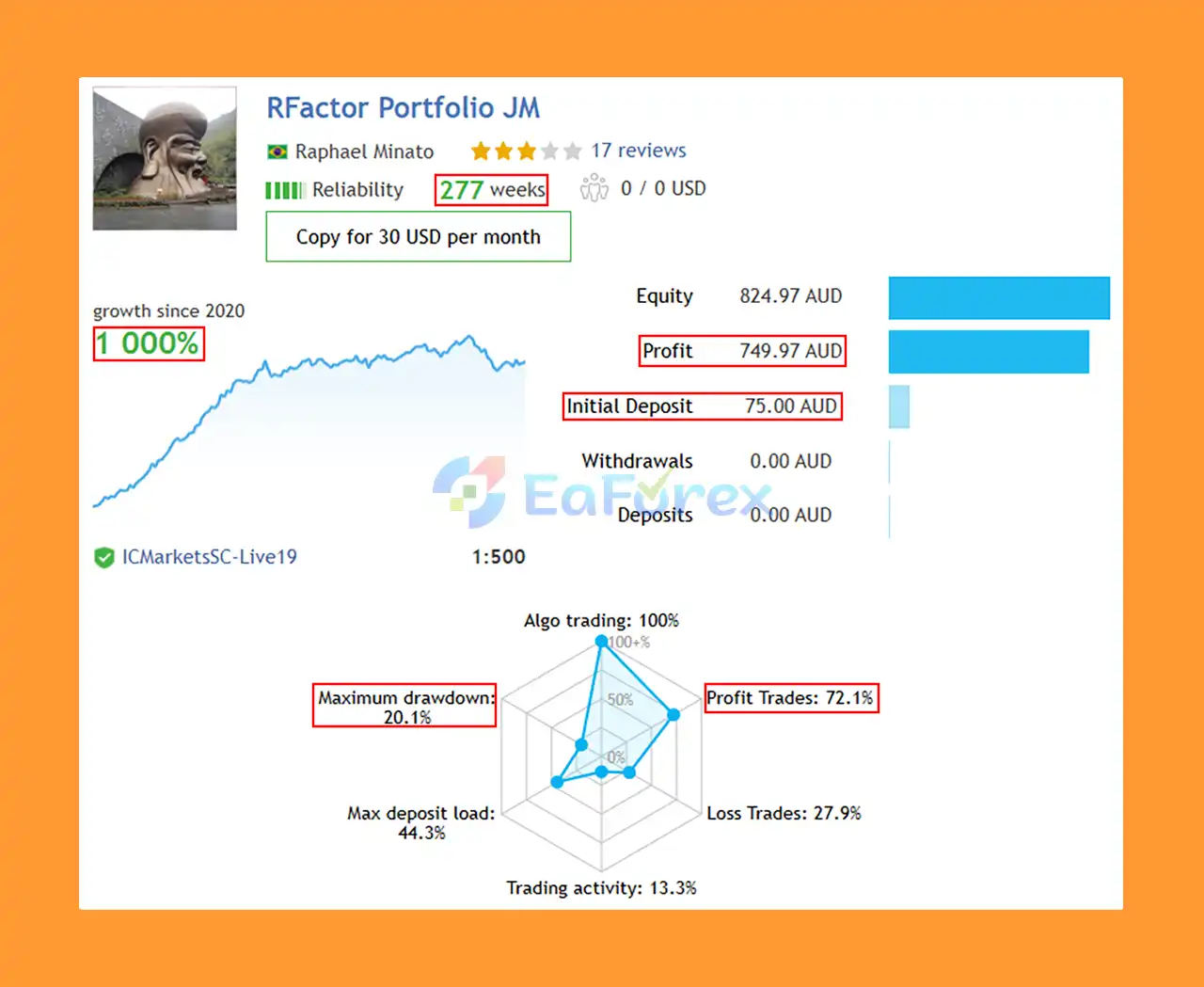
R Factor EA MT5 Live Trading Performance
- Growth Since 2020: +1.000% (277 weeks)
- Initial Deposit: 75 AUD
- Total Profit: 749.97 AUD
- Win Rate: 72%
- Maximum Drawdown: 20.1%
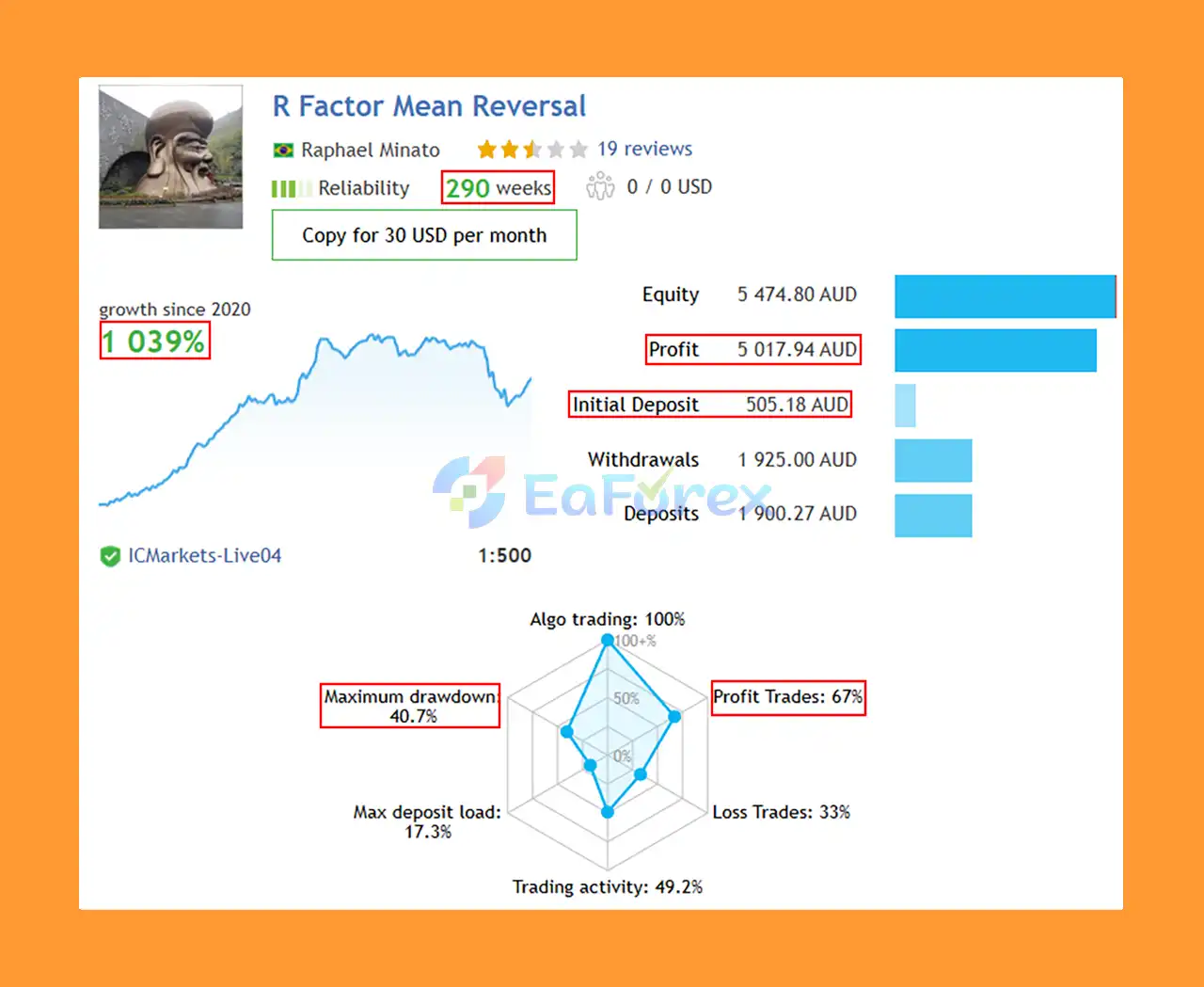
- Growth Since 2020: 1,039% (290 weeks)
- Initial Deposit: 505.18 AUD
- Total Profit: 5,017.94AUD
- Win Rate: 67%
- Maximum Drawdown: 40.7%
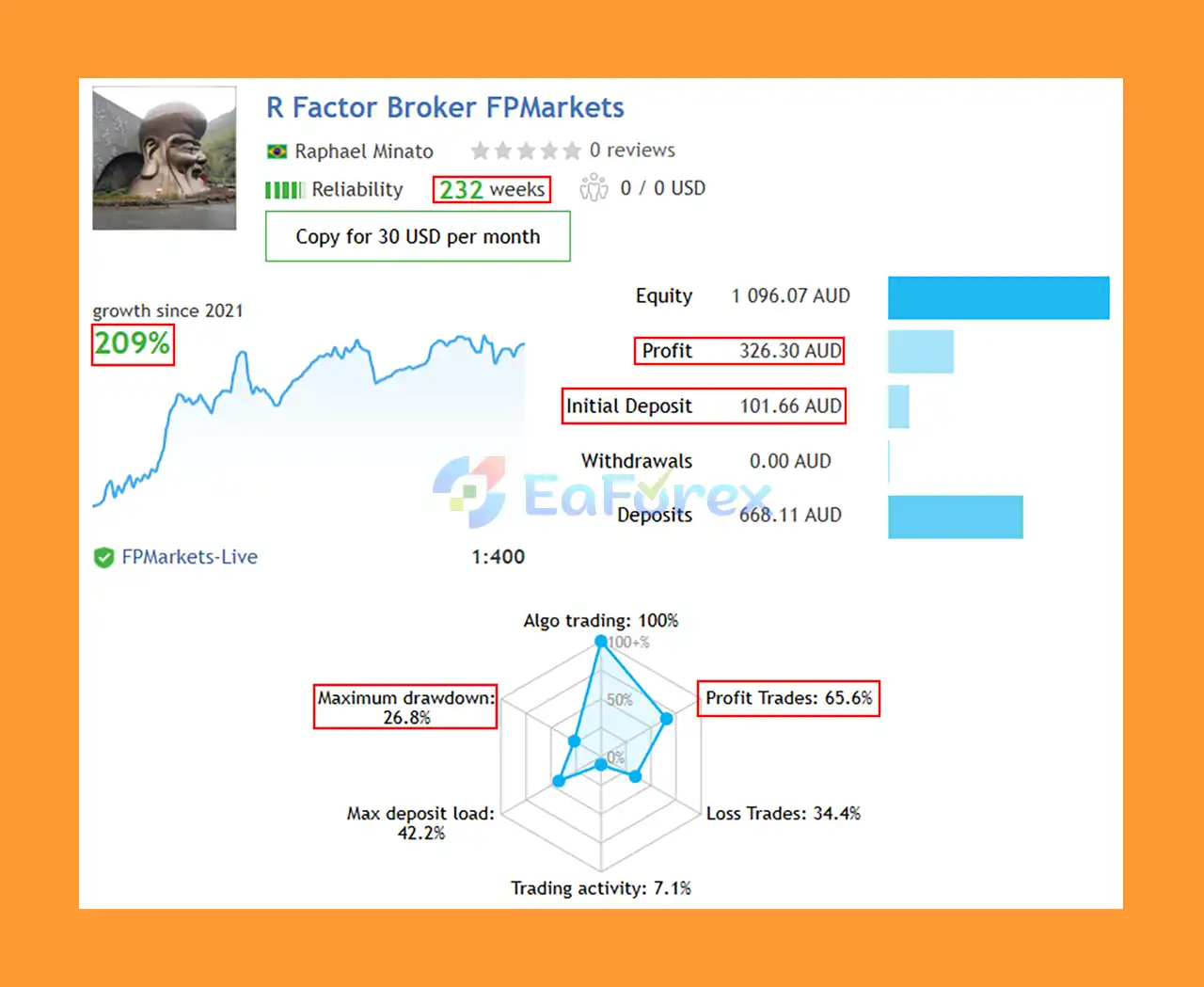
- Growth Since 2021: 209% (232 weeks)
- Initial Deposit: 101.66 AUD
- Total Profit: 326.30 AUD
- Win Rate: 65.6%
- Maximum Drawdown: 26.8%
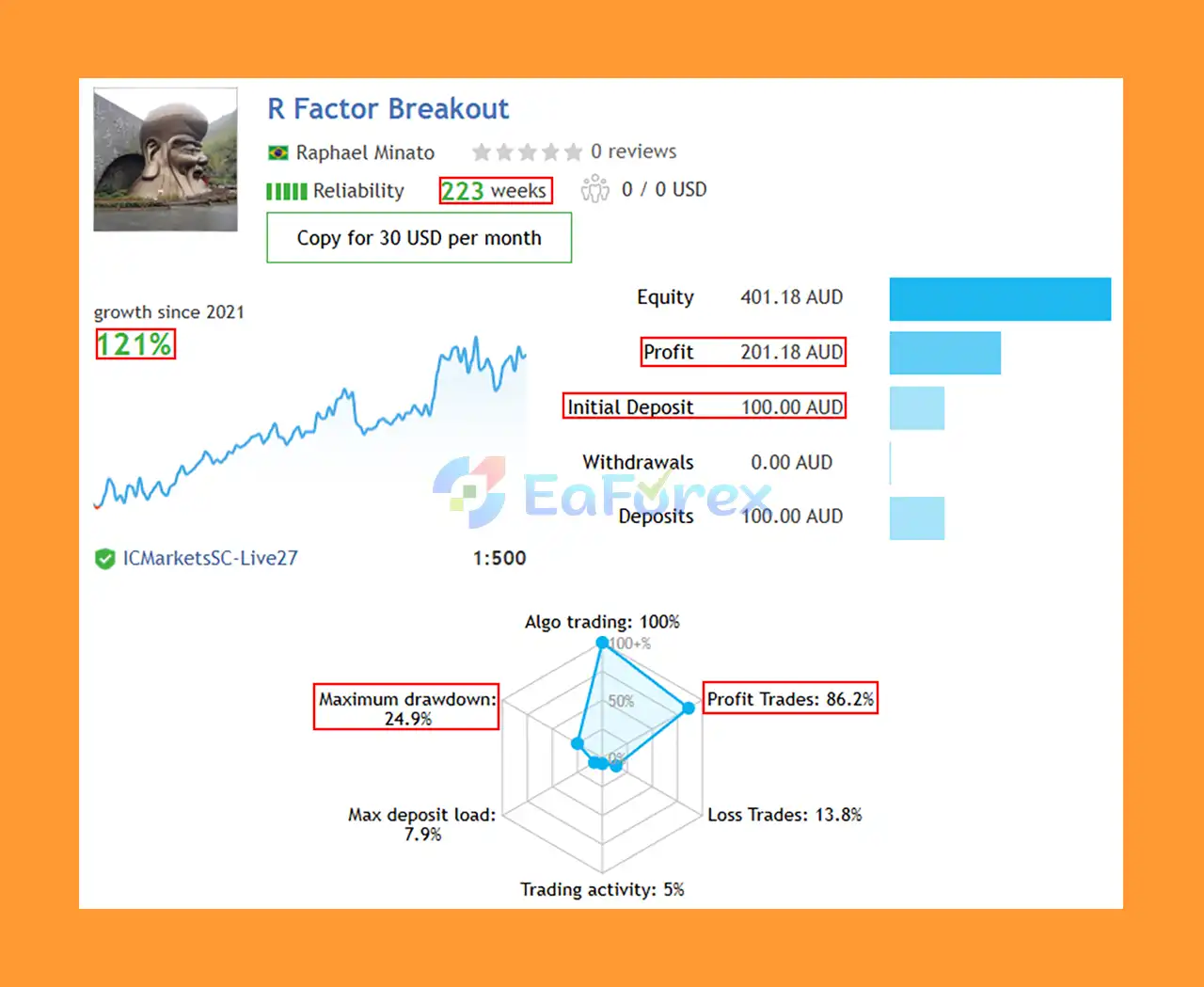
- Growth Since 2021: 121% (223 weeks)
- Initial Deposit: 100 AUD
- Total Profit: 201.18 AUD
- Win Rate: 86.2%
- Maximum Drawdown: 24.9%
Performance and Risk Management
R Factor EA MT5 combines trade-level protection with portfolio-level allocation, but its results depend on market conditions, execution quality, strategy configuration, and risk settings.
Stop Loss Protection
Each trade has a defined Stop Loss intended to limit losses at the individual-position level.
However, slippage, market gaps, and execution delays can result in losses exceeding the intended stop distance.
Dynamic Take Profit
Dynamic Take Profit allows exits to be managed according to the strategy's programmed logic rather than relying exclusively on a single static target.
Its effectiveness depends on the strategy and prevailing market conditions.
Dynamic Portfolio Balancing
The proprietary allocation algorithm increases the relative weight of stronger-performing pairs and reduces the contribution of weaker-performing ones.
This may improve capital allocation during favorable periods, but it can also increase concentration risk if a previously successful pair enters a prolonged drawdown.
No Martingale or Averaging
The absence of Martingale and averaging reduces reliance on progressively adding positions to recover losses.
Nevertheless, this does not eliminate the risk of consecutive losing trades, large individual losses, or portfolio-level drawdowns.
News Filter
The news filter is designed to help manage exposure around selected economic events.
Traders should not assume that all announcements, unexpected market shocks, or periods of poor liquidity will be avoided.
Spread and Commission Management
The developer recommends using brokers with very low spreads and fair commissions.
This is particularly important for night scalping strategies, where transaction costs can consume a significant proportion of the expected profit.
Before deploying the EA, compare live spreads, commissions, swaps, and execution quality against the assumptions used in testing.
Portfolio Diversification
Using multiple currency pairs and strategies can distribute trading opportunities across different market conditions.
However, currency pairs may become highly correlated during market stress, and diversification cannot guarantee protection against simultaneous losses.
Backtesting and Forward Testing
The reported historical performance should be treated as a starting point for further evaluation.
Traders should assess:
- Net profit after all transaction costs.
- Maximum equity drawdown.
- Profit factor and recovery factor.
- Average trade duration.
- Consecutive losses.
- Performance across different market cycles.
- Sensitivity to spreads and slippage.
- Out-of-sample and forward-testing results.
A strategy that performs well during one period may experience prolonged drawdowns in another.
Weaknesses and Risk Warnings
Despite its multi-strategy architecture, R Factor EA MT5 has several limitations that traders should understand.
Dynamic Allocation Can Increase Volatility
Giving more weight to winning pairs can increase portfolio volatility. If a previously successful pair begins to underperform, the portfolio may experience a sharp deterioration before its allocation adjusts.
Market Cycles Can Affect Strategy Performance
Night scalping and breakout strategies respond differently to volatility, liquidity, and market direction.
A prolonged change in market conditions can reduce the effectiveness of one or more strategies.
Scalping Is Sensitive to Transaction Costs
Night scalping strategies can be particularly sensitive to spread widening, commissions, slippage, and execution delays.
Broker selection can therefore have a substantial effect on live performance.
Low Starting Capital May Be Inadequate
Although the developer suggests starting capital from $30 for one pair or $100 for a 12-pair portfolio, these amounts may not provide sufficient protection against adverse market conditions.
Traders should determine their capital requirements using realistic drawdown scenarios rather than the minimum advertised balance alone.
Backtests May Not Reflect Live Trading
Historical simulations cannot reproduce every aspect of live execution, including changing liquidity, slippage, spread spikes, rejected orders, and server delays.
Default Settings Are Not Ready to Trade
The developer states that no strategy is enabled in the default settings. The correct strategy sets and recommended currency pairs must be obtained and configured before trading.
Historical Results Do Not Guarantee Future Profits
More than three years of reported positive results for certain configurations may be encouraging, but the results do not establish that every strategy, broker, or future market environment will perform similarly.
No Automated System Eliminates Risk
Even with defined Stop Loss levels and dynamic portfolio balancing, traders can experience substantial losses. Risk management reduces or controls certain exposures; it does not remove market risk.
Risk warning: Only trade with capital you can afford to lose. Test all configurations thoroughly before deploying the EA on a live account.
Pros and Cons
Pros
- Multi-strategy trading architecture.
- Combines night scalping and breakout strategies.
- Proprietary dynamic portfolio-balancing algorithm.
- Allocation weights adapt to relative pair performance.
- Defined Stop Loss on all trades.
- Dynamic Take Profit.
- Intelligent trade-exit system.
- Integrated news filter.
- One open trade per pair at a time.
- No averaging or Martingale strategies.
- Proprietary high-spread backtest simulation.
- One-chart setup for portfolio management.
- Multiple currency-pair configurations.
- Developer-reported history of positive live results for certain strategies.
- Exclusive Telegram group for eligible full-version customers.
- Regular strategy updates and configuration support.
- Low advertised starting capital requirements.
Cons
- Default settings have no trading strategies enabled.
- Requires the correct configuration sets and recommended pairs.
- Dynamic allocation can increase portfolio volatility.
- Night scalping is sensitive to spreads and commissions.
- Breakout performance can vary across market regimes.
- Low advertised starting capital may be insufficient for actual risk exposure.
- Historical results may not be reproducible.
- Broker execution quality can materially affect performance.
- Correlated pairs may experience simultaneous losses.
- No guarantee of future profitability.
How to Install R Factor EA MT5
Follow these steps to install and configure R Factor EA MT5 on MetaTrader 5.
Step 1: Open MetaTrader 5
Launch MT5 and log in to your trading account.
Step 2: Install the Expert Advisor
Navigate to:
File → Open Data Folder → MQL5 → Experts
Copy the R Factor EA MT5 file into the Experts folder.
Step 3: Refresh the Navigator
Restart MetaTrader 5 or refresh the Expert Advisors section in the Navigator panel.
Step 4: Attach the EA to a Chart
Open a chart and attach R Factor EA MT5.
The EA supports a one-chart setup for managing its configured portfolio. Follow the developer's instructions regarding the chart and account configuration.
Step 5: Obtain the Required Strategy Sets
Contact the developer to obtain the appropriate R Factor sets and recommended currency pairs.
The developer requests proof of purchase or rental before sending these configurations.
Step 6: Configure the Strategies
Load the supplied configuration sets and ensure the intended strategies and currency pairs are enabled.
Do not assume the default settings are ready for live trading. The developer explicitly states that the default configuration has no strategy enabled.
Step 7: Review Risk Parameters
Check all available inputs relating to lot sizing, trading permissions, portfolio configuration, and trade management.
Confirm that the selected configuration matches your account size, broker conditions, and risk tolerance.
Step 8: Enable Automated Trading
Enable Algo Trading in MT5 and verify that the EA is operating correctly.
Review the terminal logs and confirm that the intended strategies are active.
Step 9: Test Before Live Deployment
Run backtests using realistic spreads and commissions, then forward-test the selected configuration on a demo account.
Evaluate maximum drawdown, trade frequency, equity behavior, and sensitivity to execution costs before using real capital.
User Reviews and Feedback
- Highly rated in the MQL5 community
- Trusted by experienced traders
- Here are some Verified User Reviews:
🔻 Benjamin Greulich (2021.09.10): “This EA is profitable! You can check the live accounts. In comparison with other Night Scalpers this EA is very cheap.”
🔻 DRYX01 (2022.01.28): “Well crafted EA, and Raphael is really the most responsive author. He is a lot dedicated to customer.”
🔻 Chaikit (2022.01.11): “This EA give me consistency profit with low DD, and the author is very friendly, created a lot of trading systems for the EA. I am happy with.”
What’s Included in the Download Package?
- Setting (If Any).docx
- Installation Guide.docx
Final Thoughts
R Factor EA MT5 is a multi-strategy Forex Expert Advisor designed to address the challenges of changing market cycles through night scalping, breakout trading, and proprietary dynamic portfolio management.
Its distinguishing feature is the ability to adjust the relative weight of different currency pairs according to their performance. Combined with defined Stop Loss levels, dynamic Take Profit, intelligent trade exits, and a news filter, this approach aims to create a portfolio that can adapt as trading conditions evolve.
The EA also avoids averaging and Martingale strategies, limiting itself to one open trade per pair. This can simplify certain aspects of exposure management, although portfolio concentration and consecutive losses remain important risks.
The developer reports more than three years of positive real-account results for certain strategies and configurations. Traders should independently verify these results and understand that past performance cannot predict future outcomes.
One essential consideration is that R Factor EA MT5 requires the correct strategy sets and currency-pair configurations. Since the default settings have no strategies enabled, obtaining and installing the appropriate configuration is necessary before the EA can operate as intended.
For traders seeking an automated portfolio that combines multiple trading strategies with adaptive allocation, R Factor EA MT5 offers an interesting approach to MetaTrader 5 trading. The most responsible way to evaluate it is through careful backtesting, realistic transaction-cost assumptions, demo forward testing, and disciplined capital management.
Ultimately, successful automated trading depends not only on the EA's algorithms but also on broker execution, portfolio configuration, risk tolerance, and the ability to withstand changing market conditions.