
Product Overview
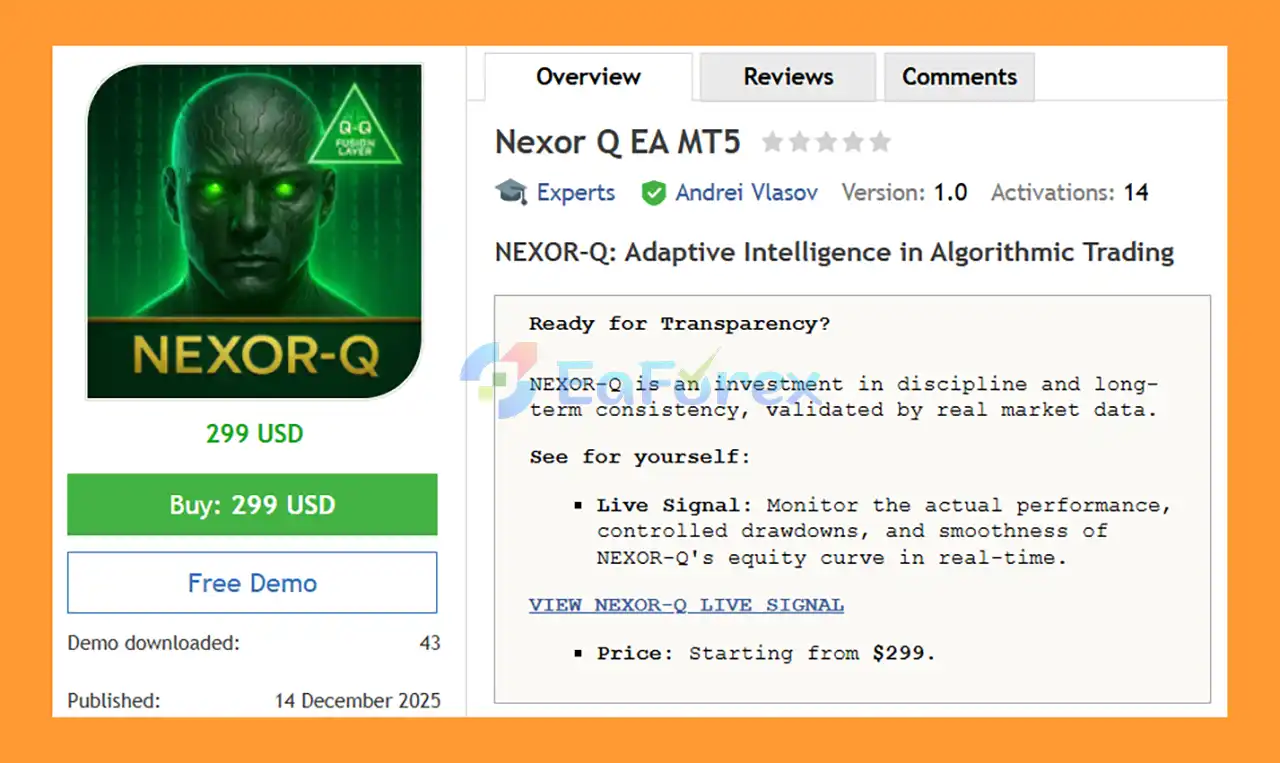
Nexor Q EA MT5 is an adaptive algorithmic trading Expert Advisor for MetaTrader 5, designed around a proprietary Fusion-Based Decision Architecture. Instead of relying solely on static combinations of traditional technical indicators, NEXOR-Q is designed to evaluate market conditions through multiple data streams before generating a trading decision.
The core of the system is the Q-Q Fusion Layer, which combines volatility measurement, behavioral price analysis, and impulse detection to assess whether current market conditions provide a suitable statistical setup.
Nexor Q also incorporates an Adaptive Risk Compression Engine, which is designed to adjust market exposure according to changing market stability. During periods of unusual volatility, the system can reduce or pause new exposure, while position sizing can expand only after predefined sequences of more stable market behavior.
Another major component is the Market Memory Filter, which uses historical market-cycle information to identify patterns that may have lost effectiveness and adapt its sensitivity to different volatility regimes.
According to the supplied product information, the system has been tested using historical data covering 2015–2025. These historical tests should be treated as research results rather than guarantees of future performance.
About the Developer
- Author: Andrei Vlasov.
- Experience: Over +2 years of experience on MQL5.
- Notable Products: Nexor Q EA MT5, Synapse Trader MT5, Paradox Flux Trader MT5, Executor AI UltraX MT5 and other advisors.
- Flagship Product: Nexor Q EA MT5 is rated as the best performing product of the year.
>> Delivery time 24h-48h after payment.
>>> Refund if not delivered.
>>> You will receive the latest version without any limitations (ID+Time).>>Reviewed by Jason Stap <<
Main Features of Nexor Q EA MT5
Fusion-Based Decision Architecture
Nexor Q EA MT5 is built around a multi-layer decision process rather than relying on a single indicator or fixed trading signal.
The architecture is designed to combine different aspects of market behavior before determining whether a trading opportunity meets the system's criteria.
Q-Q Fusion Layer
The Q-Q Fusion Layer is the central decision-making component of NEXOR-Q.
It integrates three primary data streams:
- Volatility Quantization
- Behavioral Price Analysis
- Phase-Shifted Impulse Detection
The combined output is intended to identify market conditions where the system's predefined statistical framework detects a potentially suitable trading opportunity.
Volatility Quantization
The system continuously evaluates market volatility and changes in market energy.
This includes monitoring contraction and expansion phases to help distinguish relatively stable conditions from periods of unusual volatility.
Behavioral Price Analysis
NEXOR-Q evaluates price behavior in real time to distinguish directional movement from potential mean-reversion noise.
The purpose is to assess the quality and intent of price movement rather than reacting to every short-term fluctuation.
Phase-Shifted Impulse Detection
The impulse-detection component is designed to identify potential momentum initiation points.
By monitoring changes in market behavior, the system attempts to identify developing directional movements rather than simply reacting after a trend has already become established.
Adaptive Risk Compression Engine
Nexor Q includes a dynamic risk-management component known as the Adaptive Risk Compression Engine.
Instead of using only a fixed risk percentage, the system is designed to modify exposure according to market stability.
During unstable market conditions, exposure can be compressed or new positions can be paused.
Dynamic Position Sizing
The system can increase position sizing only after predefined sequences of stable market behavior and successful trade execution.
This approach is intended to prevent the system from automatically increasing exposure during unstable conditions.
Maximum Exposure Limiter
NEXOR-Q includes an internal limiter designed to restrict maximum simultaneous market exposure.
This can help prevent the system from continuously increasing exposure beyond its predefined framework.
Market Memory Filter
The Market Memory Filter is a long-horizon component designed to analyze information from multiple market cycles.
According to the supplied description, the system has been tested across historical data from 2015 through 2025.
Pattern Degradation Detection
The Market Memory Filter is designed to identify historical patterns that may have become less effective because of changes in market structure.
Patterns considered degraded can be removed from the system's active decision framework.
Volatility Regime Adaptation
NEXOR-Q can adapt its sensitivity to different volatility environments.
This is intended to allow the system to use different execution logic during strong trends, high-volatility periods, and narrower consolidation phases.
How Does Nexor Q EA MT5 Work?
Nexor Q EA MT5 operates through several interconnected decision and risk-management layers.
Market Data Analysis
The EA continuously evaluates market information and extracts characteristics related to volatility, price behavior, and momentum.
Volatility Assessment
The Q-Q Fusion Layer evaluates the current volatility environment and attempts to determine whether market conditions are stable, expanding, contracting, or unusually volatile.
Price Behavior Analysis
The system analyzes price action to distinguish directional movement from short-term noise and potential mean-reversion behavior.
Impulse Detection
Phase-Shifted Impulse Detection searches for potential momentum initiation points that may indicate a developing directional movement.
Fusion-Based Signal Generation
The different data streams are combined through the Q-Q Fusion Layer.
Rather than depending on one fixed indicator threshold, the system attempts to determine whether multiple conditions align with its statistical decision framework.
Risk Compression
Before deploying capital, the Adaptive Risk Compression Engine evaluates market stability.
If volatility becomes unusually high or market conditions become less stable, the system can reduce exposure or temporarily pause new market activity.
Position Sizing
Position size can be adjusted according to the system's assessment of market stability and recent trading behavior.
The objective is to avoid automatically increasing exposure during unstable conditions.
Exposure Limitation
The internal exposure limiter constrains simultaneous market exposure according to the system's predefined risk framework.
Market Memory Adaptation
The Market Memory Filter evaluates longer-term historical information and attempts to identify patterns whose effectiveness may have deteriorated.
This allows the system to adjust its decision framework as market regimes change.
Why Choose Nexor Q EA MT5?
Nexor Q EA MT5 may appeal to traders interested in an adaptive algorithmic trading system for MetaTrader 5 rather than a conventional Expert Advisor based on a small collection of fixed technical indicators.
One of the system's defining characteristics is its Fusion-Based Decision Architecture. The Q-Q Fusion Layer combines volatility, price behavior, and momentum information before a trading decision is generated.
Another important component is the Adaptive Risk Compression Engine. Instead of treating every market environment identically, the system is designed to reduce exposure when market instability increases.
The Market Memory Filter provides an additional long-term adaptation layer. Its purpose is to identify historical patterns that may have degraded and adjust the system's sensitivity to changing volatility regimes.
The combination of signal filtering, adaptive exposure, and market-regime analysis makes NEXOR-Q conceptually different from a simple indicator-based EA.
However, the complexity of an algorithm does not guarantee profitability. Traders should independently evaluate live and historical results, drawdown, execution quality, risk exposure, and behavior during unfavorable market conditions before committing capital.
Nexor Q EA MT5 Performance Review
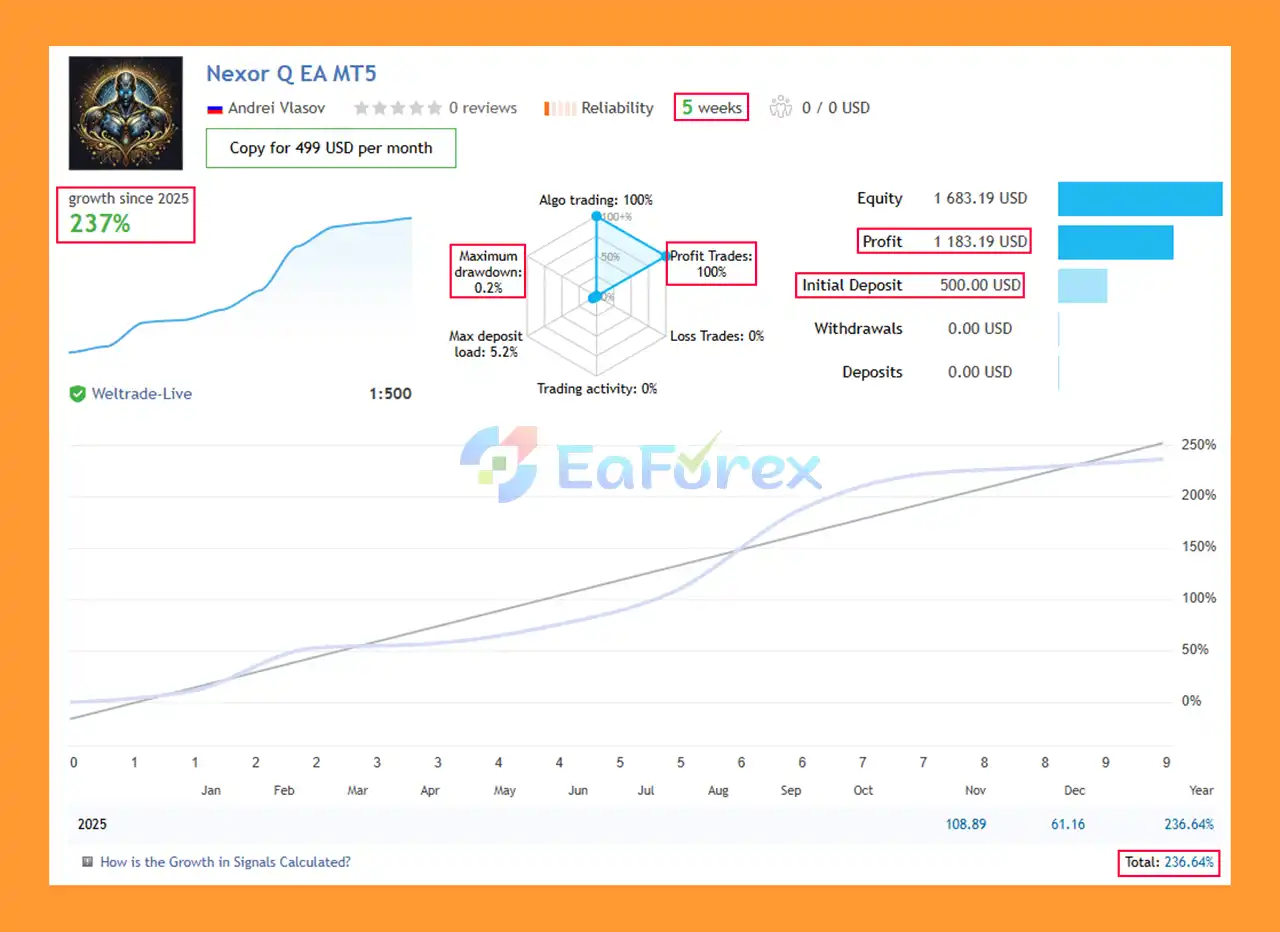
🟡Signal Results
🔺XAUUSD pair – 5 consecutive weeks
- Initial Deposit: $500
- Growth Rate: +237%
- Win Rate (% of total): 100%
- Maximum Drawdown: 0.2%
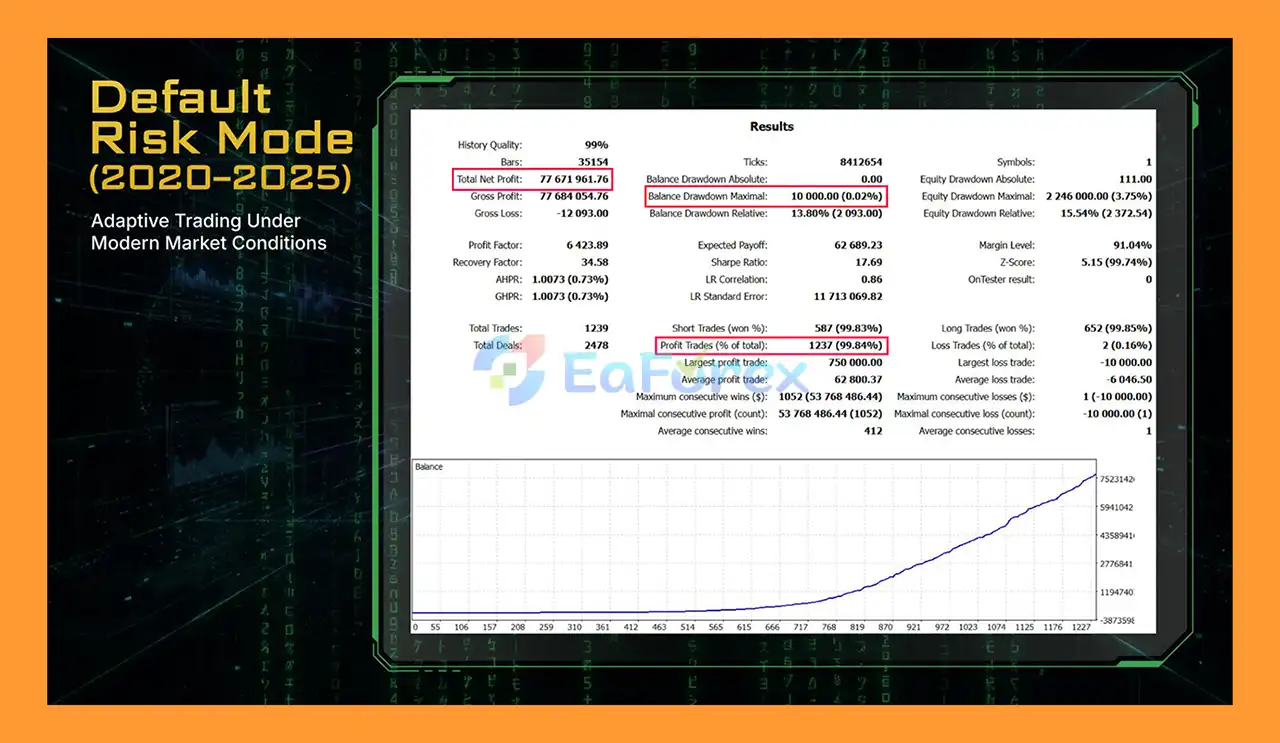
🟡Backtest Results
🔺XAUUSD pair – 5 years
- Initial Deposit: $1,000
- Total Net Profit: $77.67 million
- Win Rate (% of total): 99.84%
- Maximum Drawdown: 0.02%
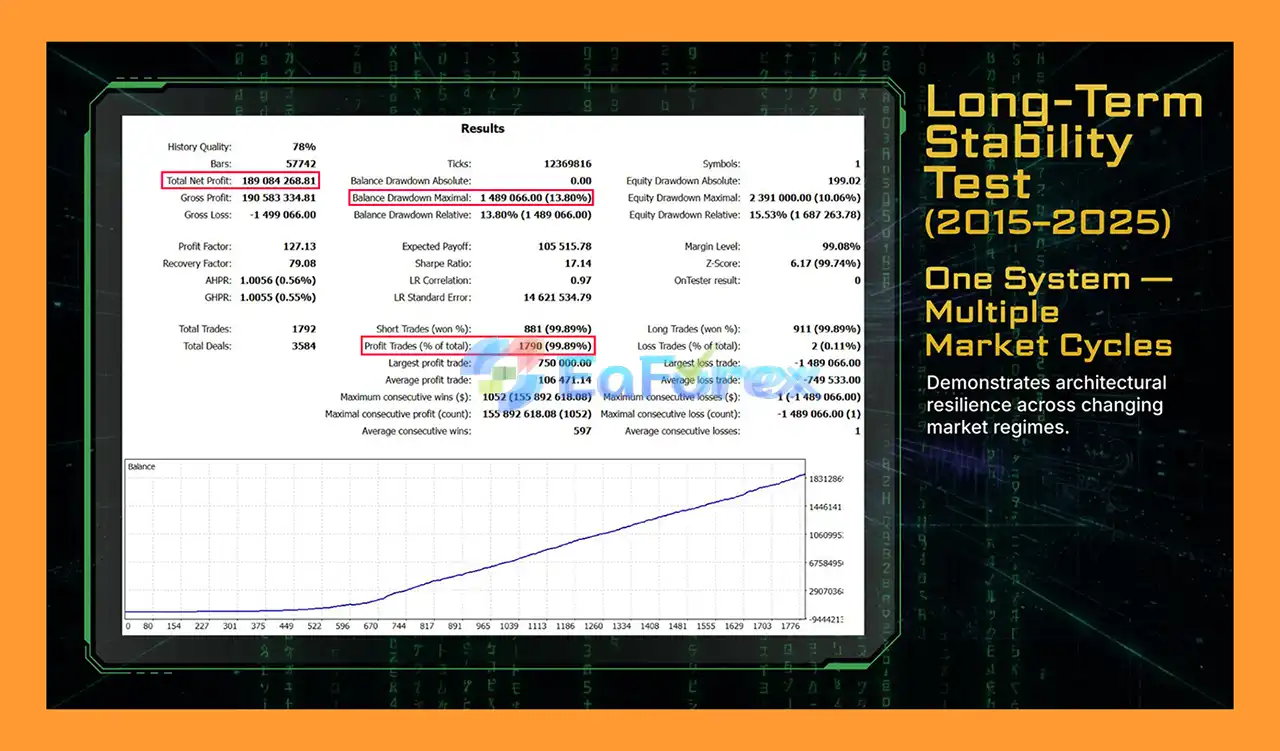
🔺XAUUSD pair – 10 years
- Initial Deposit: $1,000
- Total Net Profit: $189.08 million
- Win Rate (% of total): 99.89%
- Maximum Drawdown: 13.80%
Performance and Risk Management
Risk management is a central component of the Nexor Q EA MT5 architecture.
According to the supplied product information, the system is designed to prioritize capital preservation and controlled exposure rather than relying exclusively on aggressive position sizing.
Adaptive Exposure
The Adaptive Risk Compression Engine can reduce or pause new exposure when the market enters an unusually unstable environment.
This is intended to limit the amount of capital exposed during abnormal volatility.
Stability-Based Position Expansion
Rather than automatically increasing position sizes after every profitable trade, the system is designed to increase exposure only following predefined sequences of stable market behavior and successful execution.
Maximum Exposure Control
An internal exposure limiter is designed to constrain the maximum simultaneous market exposure.
This provides an additional layer of protection against excessive aggregate positioning.
Volatility Regime Monitoring
Market volatility is continuously considered as part of the decision architecture.
The system can adapt its sensitivity to different environments, including stronger trends and narrower consolidation periods.
Historical Market Testing
The supplied product information states that NEXOR-Q has been tested across historical market data covering 2015–2025.
Historical testing can provide useful information about how an algorithm behaved under past conditions, but it cannot guarantee how the EA will perform in future markets.
Real-World Execution Risk
Live performance can differ from historical tests because of:
- Spread
- Slippage
- Liquidity
- Commission
- Broker execution
- Market gaps
- Data differences
- Trading-session conditions
These factors should be considered when evaluating the EA.
Weaknesses and Risk Warnings
Adaptive Systems Are Not Risk-Free
Although NEXOR-Q incorporates dynamic risk controls, no automated trading system can eliminate market risk.
Unexpected market events can cause losses even when the algorithm's risk-management mechanisms are active.
Historical Testing Has Limitations
The stated 2015–2025 testing period represents historical market behavior.
Future markets can behave differently, and patterns that worked during historical periods may not remain effective.
Pattern Degradation Can Be Difficult to Predict
The Market Memory Filter is designed to identify patterns that have lost effectiveness, but there is no guarantee that every structural market change will be detected before it affects trading performance.
Volatility Spikes
Sudden volatility increases can occur faster than an automated system can respond.
This can result in unfavorable execution prices or losses despite exposure-reduction mechanisms.
Slippage and Liquidity
During fast-moving markets, actual execution prices can differ from expected prices.
Low liquidity or rapidly changing spreads can further affect trade execution.
No Guaranteed Smooth Equity Curve
The system is designed with stability and controlled exposure in mind, but this does not guarantee a smooth equity curve or consistent profitability.
Periods of drawdown are possible.
Model and Parameter Risk
Complex algorithmic systems can be sensitive to assumptions, historical data, parameter selection, and changing market structure.
A strategy that performs well during one market regime may behave differently during another.
Capital Loss
Trading financial markets involves the possibility of losing part or all of the capital allocated to an automated strategy.
Users should only trade with funds they can afford to lose and should evaluate the EA according to their own risk tolerance.
Pros and Cons
Pros
- Adaptive algorithmic trading architecture
- Designed for MetaTrader 5
- Proprietary Q-Q Fusion Layer
- Combines multiple market data streams
- Volatility-based market assessment
- Behavioral price analysis
- Momentum and impulse detection
- Adaptive exposure management
- Dynamic risk compression
- Internal maximum exposure limiter
- Market Memory Filter
- Historical pattern degradation analysis
- Volatility regime adaptation
- Designed to reduce exposure during unstable conditions
- Historical testing across 2015–2025 according to the supplied information
Cons
- Historical performance does not guarantee future results
- Complex algorithms can still experience losing periods
- Sudden volatility can create unexpected losses
- Slippage and spread can affect live execution
- Market structure can change unexpectedly
- Historical patterns may not remain effective
- Adaptive risk controls cannot eliminate market risk
- Live results may differ from backtests
- Requires ongoing monitoring and appropriate risk management
- No algorithmic trading system can guarantee consistent profits
How to Install Nexor Q EA MT5
Step 1: Obtain the EA
Download the Nexor Q EA MT5 files from the official or authorized source.
Step 2: Open MetaTrader 5
Launch the MetaTrader 5 trading platform.
Step 3: Open the MT5 Data Folder
Select:
File → Open Data Folder
Then navigate to:
MQL5 → Experts
Copy the NEXOR-Q EA files into the appropriate folder.
Step 4: Restart or Refresh MT5
Restart MetaTrader 5 or refresh the Expert Advisors section in the Navigator window.
Step 5: Open the Required Trading Chart
Open the symbol and timeframe recommended by the EA's official configuration.
Step 6: Attach NEXOR-Q
Navigate to:
Navigator → Expert Advisors
Locate Nexor Q EA MT5 and drag it onto the selected chart.
Step 7: Review the Parameters
Carefully review all available inputs before enabling automated trading.
Pay particular attention to:
- Risk settings
- Exposure limits
- Position sizing
- Trading conditions
- Maximum exposure
- Trading sessions
- Any available filters
Step 8: Enable Algo Trading
Make sure Algo Trading is enabled in MetaTrader 5 and that the EA has permission to execute trades.
Step 9: Backtest Before Live Trading
Use the MT5 Strategy Tester to evaluate the EA with historical data.
Test multiple market periods rather than relying on a single favorable period.
Review:
- Net profit
- Maximum drawdown
- Equity curve
- Trade frequency
- Exposure
- Margin usage
- Losing periods
- Performance across different market regimes
Step 10: Forward Test
After historical testing, consider running the EA on a demo account to observe its behavior under current market conditions before allocating real capital.
What’s Included in the Download Package?
- Setting (If Any).docx
- Installation Guide.docx
>>> Join VIP Membership Now <<<
Final Thoughts
In summary, Nexor Q EA MT5 is an adaptive algorithmic trading system built around a Fusion-Based Decision Architecture rather than a simple collection of static technical indicators.
Its core Q-Q Fusion Layer combines volatility quantization, behavioral price analysis, and phase-shifted impulse detection to evaluate potential market opportunities. The system then applies its Adaptive Risk Compression Engine to adjust exposure according to market stability.
The additional Market Memory Filter is designed to identify degraded historical patterns and adapt the system to changing volatility regimes. According to the supplied product information, historical testing covers the 2015–2025 period, providing a basis for evaluating how the system behaved across different historical environments.
The architecture emphasizes filtering, adaptive exposure, and risk control rather than simply maximizing trade frequency. Nevertheless, these mechanisms do not remove the fundamental risks of algorithmic trading. Market regime changes, unexpected volatility, slippage, liquidity conditions, and execution differences can all affect real-world performance.
For traders evaluating Nexor Q EA MT5, comprehensive backtesting and forward testing should be combined with careful analysis of drawdown, exposure, execution quality, and behavior during unfavorable market conditions. Historical results can provide useful evidence about past behavior, but they should not be interpreted as a guarantee of future returns.