



Product Overview
Scai MT5 EA is an automated MetaTrader 5 Expert Advisor designed around a breakout strategy that identifies potential opportunities when price breaks through significant market extremes.
The EA continuously analyzes market behavior and attempts to adapt its trading decisions to prevailing market trends. Instead of relying on a large number of manually optimized settings, Scai is designed to calculate and optimize many of its key trading parameters automatically.
One of the main characteristics of Scai MT5 is its evaluation of the relationship between Take Profit (TP), Stop Loss (SL), and the estimated probability of a positive trade outcome before entering the market.
The system uses a fixed Stop Loss, trailing-stop-based profit management, and automated trade analysis to determine whether a potential setup meets its internal criteria.
According to the product information, the strategy has also been tested against historical market data covering approximately 20 years. However, historical testing cannot guarantee future live-trading performance, and actual results can vary depending on broker conditions, spreads, slippage, execution, and market behavior.
The primary recommended setup is EURUSD on the M5 timeframe, with leverage of 1:100 or higher.
About the Developer
- Author: Mikita Kurnevich
- Experience: Over +1 years of experience on MQL5.
- Notable Products: Scai MT5, RT Pro Symbiosis MT5, ProTrade USDJPY MT5 and other advisors
- Flagship Product: Scai MT5 is rated as the best performing product of the year.
>> Delivery time 24h-48h after payment.
>>> Refund if not delivered.
>>> You will receive the latest version without any limitations (ID+Time).>>Reviewed by Jason Stap <<
Main Features of Scai MT5
Strong Extremes Breakout Strategy
Scai MT5 focuses on price breakouts through significant market extremes.
The strategy attempts to identify areas where price breaks an important high or low and then evaluates whether the resulting setup provides suitable trading conditions.
Automated Market Analysis
The EA continuously analyzes market conditions and adjusts its trading decisions according to the detected market trend.
This removes the need for the trader to manually identify every potential breakout setup.
TP/SL Ratio Analysis
Before entering a trade, Scai evaluates the relationship between its potential Take Profit and Stop Loss levels.
The system also considers its internal estimate of the probability of a positive outcome before deciding whether to execute a trade.
Fixed Stop Loss
Every trade uses a predefined Stop Loss according to the strategy's internal calculations.
A fixed SL provides a clearly defined exit level and helps establish a predetermined risk boundary for each position.
Trailing Stop Profit Management
Scai includes a trailing-stop mechanism designed to manage profitable positions as price moves in the expected direction.
The trailing mechanism can help protect part of an open trade's accumulated profit while allowing the position to remain active when market momentum continues.
Automated Parameter Optimization
The EA is designed with a relatively small number of user-configurable parameters.
Many of the main trading calculations and optimization processes are handled automatically by the algorithm.
This can make the system easier to configure compared with EAs that require extensive manual optimization.
Historical Strategy Testing
According to the product description, the trading strategy has been tested using historical data covering approximately 20 years.
Long-term historical testing can provide useful information about how a strategy behaved under different market environments, although it should not be treated as evidence of guaranteed future performance.
Flexible Lot Management
Scai provides two main lot-sizing approaches:
- Dynamic Lot – lot size is calculated dynamically according to the system's configuration.
- Fixed Lot – uses a predefined lot size.
This allows traders to choose between a fixed position size and a dynamically calculated position size.
Magic Number
The Magic Number parameter allows the EA to identify and manage its own trades separately from other Expert Advisors or manual positions running on the same MetaTrader 5 account.
How Does Scai MT5 EA Work?
Scai MT5 operates through several automated stages designed to identify and evaluate potential breakout opportunities.
Step 1: Market Analysis
The EA continuously analyzes price data on the selected trading instrument and timeframe.
Its primary focus is identifying significant market extremes that may become relevant breakout levels.
Step 2: Extreme Level Detection
Scai searches for important highs and lows within the market structure.
These areas form the basis for identifying potential breakout conditions.
Step 3: Breakout Identification
When price moves through a significant extreme, the EA evaluates whether the movement meets its internal breakout criteria.
Rather than entering every breakout automatically, the system performs additional calculations before opening a position.
Step 4: TP and SL Evaluation
Scai calculates the relationship between the potential Take Profit and Stop Loss.
The EA also evaluates the estimated probability of a positive trade outcome according to its internal algorithm.
Only when the setup satisfies the required conditions does the system consider entering the market.
Step 5: Automated Trade Execution
Once all conditions are met, Scai can automatically open a position without requiring manual intervention.
The initial trade is protected by the strategy's predefined Stop Loss.
Step 6: Profit Management
If the trade moves favorably, the trailing-stop mechanism can progressively adjust the protective level according to the EA's trading logic.
This allows the system to manage profitable trades automatically rather than relying entirely on a fixed exit.
Step 7: Automatic Exit
The position is eventually closed when the relevant Take Profit, Stop Loss, trailing-stop, or other strategy conditions are triggered.
This creates a fully automated trading cycle from market analysis through trade management and exit.
Why Choose Scai MT5?
Scai MT5 may be suitable for traders who are interested in an automated breakout trading strategy with limited manual configuration.
Automated Breakout Analysis
The EA automatically searches for potential breakouts around significant market extremes, reducing the need for manual chart monitoring.
Minimal Configuration
Scai is designed around a relatively small number of user parameters because many important calculations are performed automatically.
This can simplify the initial setup process.
Built-In Risk Structure
The use of a fixed Stop Loss provides a predefined exit mechanism for each trade.
The EA also incorporates TP/SL evaluation and trailing-stop management as part of its trading process.
Trend-Aware Trading Logic
The system analyzes market behavior and adjusts its decisions according to the detected trend conditions rather than simply executing trades at every price breakout.
Long-Term Historical Testing
The reported use of approximately 20 years of historical market data provides a broad testing period for evaluating how the strategy behaved across different historical environments.
However, historical testing remains backward-looking and cannot predict future market performance.
EURUSD M5 Focus
The recommended configuration is EURUSD M5, giving traders a specific starting point for testing instead of requiring them to immediately optimize the EA across numerous symbols and timeframes.
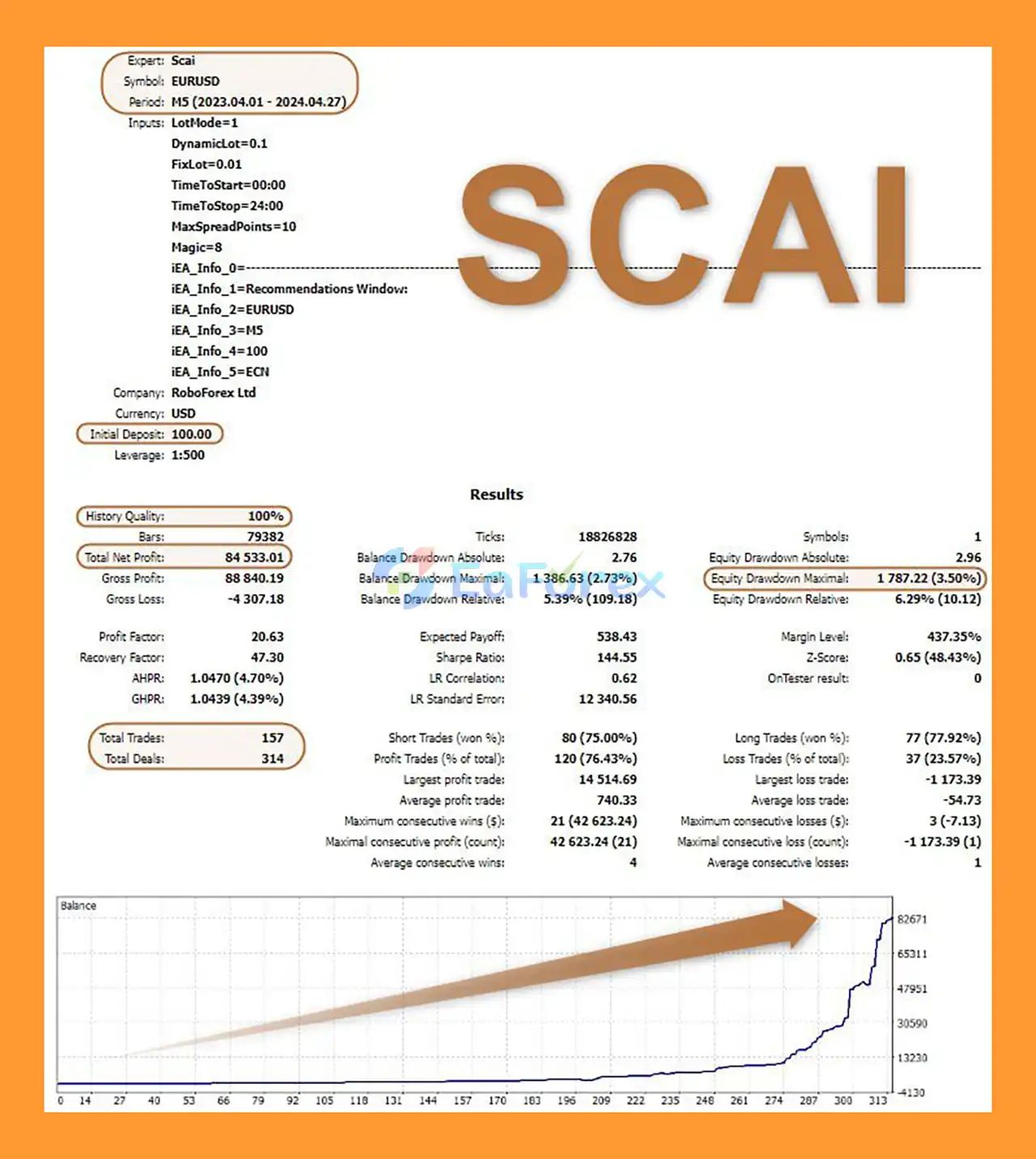
Scai MT5 Backtest Results
🔺EURUSD - 12 months
- Initial Deposit: $100
- Total Net Profit: $84,533
- Win Rate (% of total): 76.43%
- Maximum Drawdown: 3.50%
Performance and Risk Management
Scai MT5 incorporates several mechanisms intended to control trade risk and manage open positions.
Fixed Stop Loss
A fixed Stop Loss is used to define the maximum planned price movement against an individual position before the trade is automatically closed.
This is an important component of the strategy's risk structure.
TP/SL Ratio
Before entering a trade, the EA calculates the relationship between its potential Take Profit and Stop Loss.
This helps the algorithm assess whether the potential reward relative to the defined risk meets its internal requirements.
Probability Assessment
The EA also evaluates the estimated probability of a positive outcome before entering the market.
This probability is generated by the system's own algorithm and should not be interpreted as a guarantee that a trade will be profitable.
Trailing Stop
The trailing-stop system dynamically manages trades that move in the desired direction.
Its purpose is to protect accumulated profit or reduce potential giveback while allowing profitable positions to remain open when market momentum continues.
Dynamic Lot Sizing
The Dynamic lot option can adjust position sizing according to the EA's configured methodology.
Because dynamic position sizing can materially affect drawdown and account exposure, users should carefully evaluate its behavior through backtesting and demo trading.
Fixed Lot Sizing
The Fix option allows users to operate with a predefined lot size.
This can make position exposure easier to understand because the nominal lot size remains constant.
Historical Testing
The strategy has reportedly been tested against approximately 20 years of historical data.
When reviewing such tests, traders should examine more than the final profit figure. Important metrics include:
- Maximum drawdown
- Profit factor
- Average trade
- Consecutive losses
- Recovery period
- Number of trades
- Equity curve
- Spread assumptions
- Commission
- Slippage
Actual live performance can differ substantially from historical backtests.
Weaknesses and Risk Warnings
Although Scai MT5 includes several risk-management features, automated breakout trading still carries significant market and execution risks.
Breakout False Signals
A breakout through a market extreme does not necessarily lead to a sustained trend.
Price can break a high or low and then quickly reverse, potentially resulting in a Stop Loss.
M5 Market Noise
The recommended EURUSD M5 configuration operates on a relatively short timeframe.
Lower timeframes can be more sensitive to market noise, spread changes, slippage, and short-term price fluctuations.
ECN Account Warning
The product specifically provides a warning regarding ECN accounts.
Traders should therefore carefully check the official documentation and broker compatibility before deploying Scai on an ECN account.
Execution and Slippage
Live execution can differ from historical testing.
Factors such as:
- Spread
- Slippage
- Execution speed
- Liquidity
- Commission
- Broker infrastructure
can affect the actual entry and exit prices.
Leverage Risk
The recommended leverage is 1:100 or higher. High leverage can significantly increase both potential returns and potential losses.
Leverage should therefore be considered carefully when determining position size and account risk.
Dynamic Lot Risk
Dynamic lot sizing can increase or decrease position exposure depending on its calculation methodology.
Users should understand how lot size changes before enabling this mode on a live account.
Historical Results Are Not Guaranteed
Even a long historical backtest cannot guarantee future profitability.
Financial markets change over time, and a strategy that performed under historical conditions may behave differently in future market environments.
Minimum Deposit Consideration
Although the product description states a minimum deposit of $10, this should not automatically be interpreted as a recommended live-trading capital level.
A very small account can be highly sensitive to lot size, spread, margin requirements, and transaction costs.
Pros and Cons
| Pros | Cons |
|---|---|
| Automated breakout trading strategy | Breakouts can produce false signals |
| Focuses on significant market extremes | M5 trading can be sensitive to market noise |
| Automated TP/SL analysis | Estimated probability does not guarantee profitable trades |
| Fixed Stop Loss | Stop Loss cannot prevent losses caused by all execution conditions |
| Trailing-stop profit management | Trailing stops can close positions during temporary pullbacks |
| Minimal user parameters | Less manual control may not suit every trading style |
| Automatic parameter calculations | Internal calculations may be difficult to evaluate independently |
| Dynamic or fixed lot options | Dynamic sizing can increase account exposure |
| Long historical testing period | Historical performance does not guarantee future results |
| Magic Number support | Broker conditions can affect live performance |
| Recommended EURUSD M5 configuration | ECN-account compatibility requires particular attention |
How to Install Scai MT5
Step 1: Install MetaTrader 5
Install MetaTrader 5 through your broker or the official MT5 platform.
Step 2: Open the Data Folder
In MetaTrader 5, go to:
File → Open Data Folder → MQL5 → Experts
Step 3: Copy the EA
Place the Scai MT5 EA file into the Experts folder.
If the product package contains additional files, follow the supplied installation instructions for the correct MT5 directories.
Step 4: Restart MT5
Restart MetaTrader 5 or refresh the Navigator → Expert Advisors section.
Scai MT5 should then appear in the list of available Expert Advisors.
Step 5: Open the Recommended Chart
The recommended starting configuration is:
Symbol: EURUSD
Timeframe: M5
Step 6: Attach Scai MT5
Drag the EA onto the EURUSD M5 chart and enable Algo Trading.
Check the EA's permissions and make sure automated trading is enabled in MetaTrader 5.
Step 7: Configure the Parameters
The primary parameters include:
Lots
Select the preferred position-sizing system.
Dynamic
Uses the EA's dynamic lot-sizing approach.
Fix
Uses a fixed lot size.
Magic
Defines the Magic Number used by the EA to identify its own trades.
Because Scai is designed to calculate many of its core parameters automatically, users should avoid making unnecessary changes without understanding their effect.
Step 8: Backtest the Strategy
Before live deployment, use the MT5 Strategy Tester to evaluate the EA with appropriate historical data.
Pay particular attention to:
- Maximum drawdown
- Trade frequency
- Consecutive losses
- Equity curve
- Spread
- Commission
- Slippage
- Lot sizing
Step 9: Forward Test
Run Scai MT5 on a demo account before using real capital.
This can help identify differences between historical testing and actual broker execution.
Step 10: Consider VPS Hosting
For continuous automated trading, a reliable VPS can help keep MetaTrader 5 online and reduce interruptions caused by a local computer being switched off or disconnected.
What’s Included in the Download Package?
🔺 Experts:
- Setting (If Any).docx
- Installation Guide.docx
Final Thoughts
Scai MT5 EA is an automated breakout Expert Advisor designed to trade around strong market extremes, with EURUSD M5 listed as the primary recommended configuration.
Its trading process combines breakout detection with automated analysis of the TP/SL relationship and estimated trade probability before entering the market. The system also uses a fixed Stop Loss, trailing-stop profit management, and automated position sizing options while keeping the number of user-configurable parameters relatively small.
One of the notable characteristics of Scai MT5 is its emphasis on automatic calculation and optimization of key strategy parameters. According to the product information, the strategy has also been evaluated using approximately 20 years of historical data, providing a broad historical period for testing.
However, traders should not evaluate the EA solely by historical profitability. False breakouts, M5 market noise, slippage, spreads, leverage, broker execution, and dynamic position sizing can all materially affect live results.
The recommended approach is to first test Scai MT5 using the EURUSD M5 configuration, carefully review its drawdown and trade behavior, and conduct forward testing on a demo account before considering live deployment.
Scai MT5 is a technical trading automation tool and does not guarantee profits. Past backtest performance does not guarantee future results, and trading financial markets involves the risk of losing capital.