









-
 Unlimited Activations
-
 Instant delivery
-
 Easy to install





 Unlimited Activations
Instant delivery
Easy to install
Unlimited Activations
Instant delivery
Easy to install
 Free Update
 Free Install Support

GM Grid MT5 is a fully automated and semi-automatic MetaTrader 5 Expert Advisor based on a combination of Price Action, Grid, and Martingale trading techniques. The EA is designed to identify trading opportunities through its Price Action strategy while using a grid-based position structure for trade management.
GM Grid MT5 can be used on a range of trading instruments, including XAUUSD, EURUSD, GBPUSD, USDJPY, and other suitable symbols. It supports multiple timeframes, from M1 and above, with the developer indicating that larger timeframes may provide more stable signals.
The EA is optimized for use with low-spread currency pairs and is designed to be relatively simple to install. It can operate in either fully automated or semi-automatic mode, depending on the trader’s preferred workflow.
Because GM Grid MT5 combines grid and martingale techniques, appropriate capital, leverage, and risk management are particularly important when configuring the EA.
>> Delivery time 24h-48h after payment.
>>> Refund if not delivered.
>>> You will receive the latest version without any limitations (ID+Time).>>Reviewed by Jason Stap <<
GM Grid’s core trading approach is based on Price Action.
The EA analyzes market price behavior to identify potential trading opportunities and then applies its position-management logic according to the configured settings.
GM Grid MT5 incorporates a Grid trading technique.
Instead of relying exclusively on a single entry, the EA can use additional positions as price moves through predefined or strategy-determined levels.
Grid trading can provide opportunities to manage a position through multiple entries, but it can also increase total market exposure when the market moves strongly against the initial position.
GM Grid MT5 also uses a Martingale technique.
Depending on the configured strategy, subsequent trades may increase exposure following adverse price movement.
This approach can potentially accelerate recovery when the market reverses as expected, but it also creates substantially higher risk if a strong directional move continues.
GM Grid MT5 can be used in two different ways:
This provides flexibility for traders who want the EA to manage the entire process or prefer to maintain some level of manual control.
The EA can be used with various instruments, including:
The developer recommends focusing on instruments with suitable spread and liquidity conditions.
GM Grid MT5 supports different timeframes beginning from M1 and above.
According to the developer, larger timeframes may provide more stable signals. Traders should therefore compare different timeframes through backtesting before choosing a live configuration.
GM Grid MT5 is optimized for low-spread currency pairs.
Although the developer describes the EA as not sensitive to broker conditions, spread and execution quality can still affect the actual outcome of any automated trading strategy.
GM Grid MT5 is designed to be easy to install.
After purchasing the product, traders can contact the developer for additional support and setup assistance.
The developer also provides support tools intended to help users configure and potentially improve the EA’s performance.
GM Grid MT5 combines Price Action signals with Grid and Martingale-based position management.
The EA can be attached to instruments such as XAUUSD, EURUSD, GBPUSD, and USDJPY.
Low-spread instruments are preferred according to the developer’s recommendations.
GM Grid MT5 supports M1 and higher timeframes.
While lower timeframes can provide more frequent signals, the developer indicates that larger timeframes generally provide more stable signals.
The EA analyzes price behavior according to its programmed Price Action strategy.
When the required conditions are identified, GM Grid can initiate a trade.
If the market moves against the initial position, the EA can use its grid mechanism to open additional positions according to the configured strategy.
This creates a multi-order position structure.
The EA can also use Martingale position sizing, potentially increasing the lot size of subsequent positions.
The objective is to allow a later favorable price movement to offset previous losses and potentially close the overall trading sequence.
However, this mechanism can significantly increase exposure during prolonged adverse market movements.
When the required market and position conditions are reached, the EA closes the relevant positions according to its programmed trade-management logic.
The exact outcome depends on market movement, account size, leverage, spread, and the selected configuration.
GM Grid MT5 combines Price Action analysis with grid-based position management, giving the system a different structure from simple single-entry EAs.
The EA can automate the trading process, reducing the need for manual order placement and continuous chart monitoring.
Traders who want greater control can use the semi-automatic functionality instead of relying entirely on automated execution.
Support for XAUUSD, EURUSD, GBPUSD, USDJPY, and other symbols provides flexibility when selecting a trading instrument.
The ability to use different timeframes allows traders to test configurations ranging from short-term M1 setups to higher-timeframe approaches.
After purchasing the EA, users can contact the developer for assistance. Additional support tools are also provided to help with configuration and performance testing.
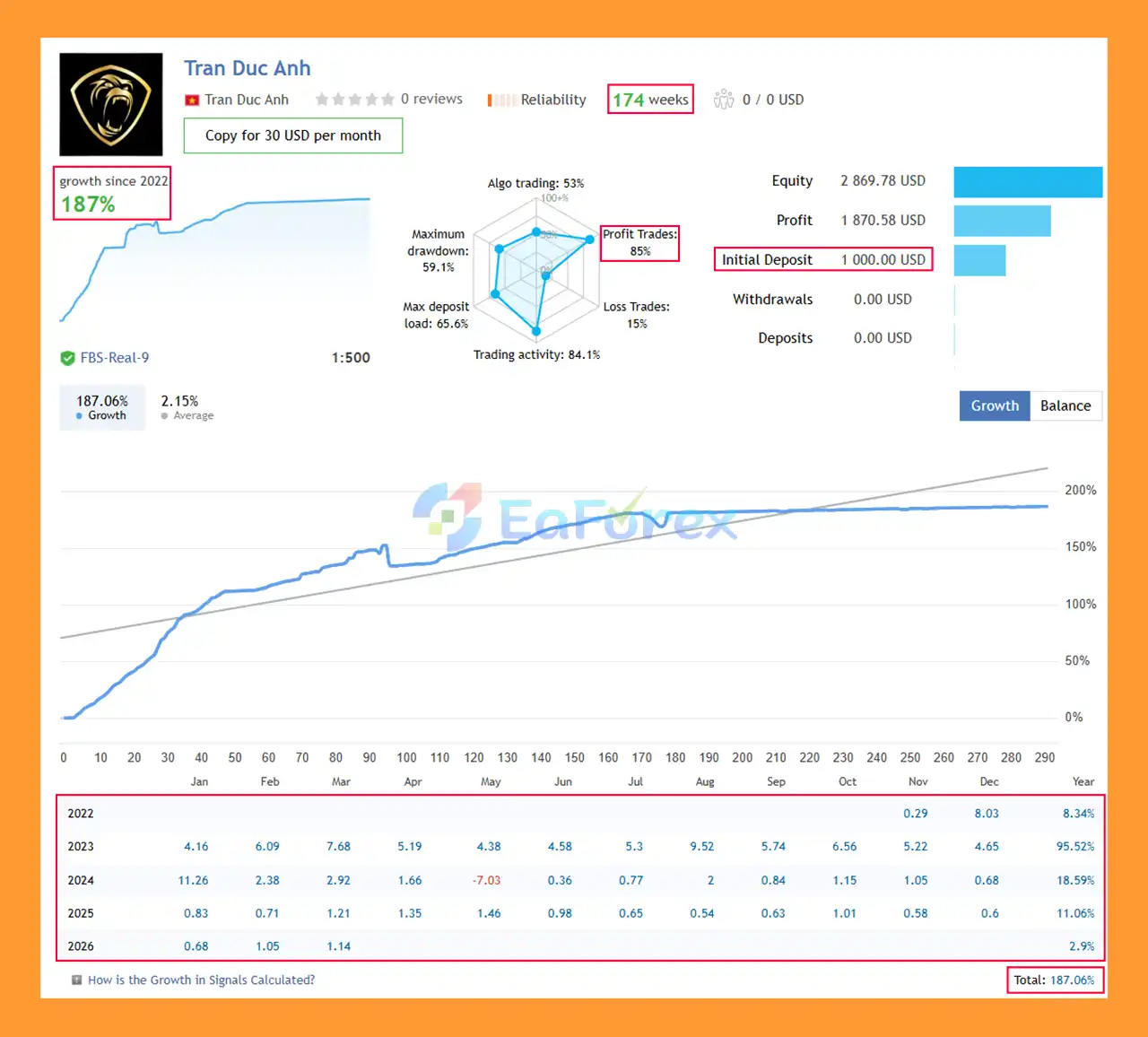
🔺 XAUUSD (Gold), EURUSD, GBPUSD pair– 174 consecutive weeks of trading
GM Grid MT5 Signal Results
Risk management is particularly important with GM Grid MT5 because the EA uses both Grid and Martingale techniques.
The developer specifies a minimum deposit of $125 when Stop Loss settings are used, or the equivalent amount in a cent account.
Using a Stop Loss can help limit downside exposure, although it cannot eliminate the possibility of losses or execution differences during fast market conditions.
The developer recommends a minimum deposit of $1,500 without Stop Loss settings, or the equivalent amount in a cent account.
This recommendation should not be interpreted as meaning that a $1,500 account is protected from significant losses. Removing Stop Loss can expose the account to substantially larger drawdowns, particularly when Grid and Martingale techniques are active.
The developer specifies that 1:500 leverage is required.
High leverage increases the ability to control larger positions with a smaller amount of margin, but it also increases the potential speed and magnitude of account losses.
Grid systems can accumulate multiple open positions when price moves against the initial trade.
As more positions are added, the total exposure and required margin can increase.
Martingale position sizing can increase the size of subsequent trades after adverse movements.
This means that a prolonged trend against the trading direction can create rapidly increasing account exposure.
The EA is optimized for low-spread currency pairs.
Lower spreads can reduce transaction costs, particularly when multiple orders are involved. However, traders should also consider commissions and slippage.
Because GM Grid combines two high-exposure techniques, traders should pay close attention to risk.
Avoid selecting a lot size simply because the backtest produces a higher return. The initial lot size directly influences the exposure of subsequent Grid and Martingale positions.
Do not evaluate the EA based solely on its winning percentage or net profit. Maximum drawdown and the duration of losing sequences are equally important.
A meaningful backtest should include periods where the market moves strongly in one direction.
This is particularly important for Grid and Martingale systems because prolonged trends can create large position sequences.
The developer provides a $125 minimum deposit recommendation when Stop Loss settings are used. Traders who prioritize capital protection should carefully evaluate configurations with an appropriate SL rather than assuming that removing the SL is safer because a larger balance is used.
Although 1:500 leverage is specified as required, traders should understand that leverage does not reduce trading risk. It increases the amount of market exposure that can be controlled relative to available margin.
When the market continues moving against a position, Grid strategies can open additional orders. This can cause total exposure to grow rapidly.
The use of Martingale means that position sizes can increase after unfavorable movements. A prolonged losing sequence can therefore produce losses that are significantly larger than the initial trade risk.
The developer’s $1,500 recommendation for configurations without Stop Loss should not be considered a substitute for risk management.
Without a Stop Loss, adverse market movements can continue to increase floating losses and margin requirements.
A 1:500 leverage requirement can provide substantial trading capacity, but it can also amplify the consequences of poor position sizing or prolonged adverse market conditions.
When GM Grid MT5 is used on XAUUSD, traders should expect significantly greater price volatility than on many major Forex pairs.
Gold can move rapidly during major economic announcements, geopolitical events, and changes in market liquidity.
Low spreads can help reduce transaction costs, but they do not prevent losses caused by incorrect market direction, grid accumulation, or Martingale exposure.
Strategy Tester results can differ from live results because of:
The developer provides additional support tools after purchase, but these tools should be treated as configuration or assistance resources rather than a guarantee of improved profitability.
1. What is GM Grid MT5?
GM Grid MT5 is an automated and semi-automated Expert Advisor (EA) for MetaTrader 5 that uses Price Action strategies, grid, and martingale techniques to execute high-probability trades and maximize profit potential.
2. Who can use GM Grid MT5?
This EA is suitable for both beginner and professional traders, offering flexible automation options and low deposit requirements for cent or standard accounts.
3. How does GM Grid MT5 work?
The EA analyzes market movements using Price Action patterns and executes trades automatically or semi-automatically, while grid and martingale systems manage order scaling to enhance profits.
4. What currency pairs and assets are best for GM Grid MT5?
GM Grid MT5 is optimized for low-spread currency pairs such as EURUSD, GBPUSD, USDJPY, and precious metals like XAUUSD (Gold). It can also be customized for other trading pairs.
5. Can GM Grid MT5 work on multiple timeframes?
Yes, it supports M1 and higher timeframes. Larger timeframes provide more stable signals, while smaller timeframes allow more frequent trading opportunities.
6. What are the main features of GM Grid MT5?
Key features include fully and semi-automated modes, grid and martingale strategies, automatic order management, customizable Stop Loss settings, easy installation, and broker-agnostic performance.
7. How profitable is GM Grid MT5?
Signal results on XAUUSD, EURUSD, and GBPUSD show a growth rate of +187% from a $1,000 deposit, with an 85% win rate over 174 consecutive weeks and maximum drawdown of 59.1%.
8. What deposit is needed to use GM Grid MT5?
Minimum recommended deposits are $125 with Stop Loss enabled or $1,500 without Stop Loss, optimized for leverage of 1:500.
9. How customizable is GM Grid MT5?
Traders can adjust Stop Loss, grid spacing, risk management, and timeframe settings, while additional support tools help optimize performance and reduce trading risks.
10. Why choose GM Grid MT5 over other EAs?
It combines high-probability Price Action trading, profit-maximizing grid and martingale systems, easy setup, reliable automation, and flexible account compatibility, making it suitable for traders seeking scalable and low-maintenance MT5 solutions.
In stock
In stock
In stock
In stock
In stock
Out of stock
No account yet?
Create an Account











 Automatic EA
 EA Best Seller
 Expert Advisor MT4
 Expert Advisor MT5
 HFT EA


Reviews
Clear filtersThere are no reviews yet.