

Product Overview
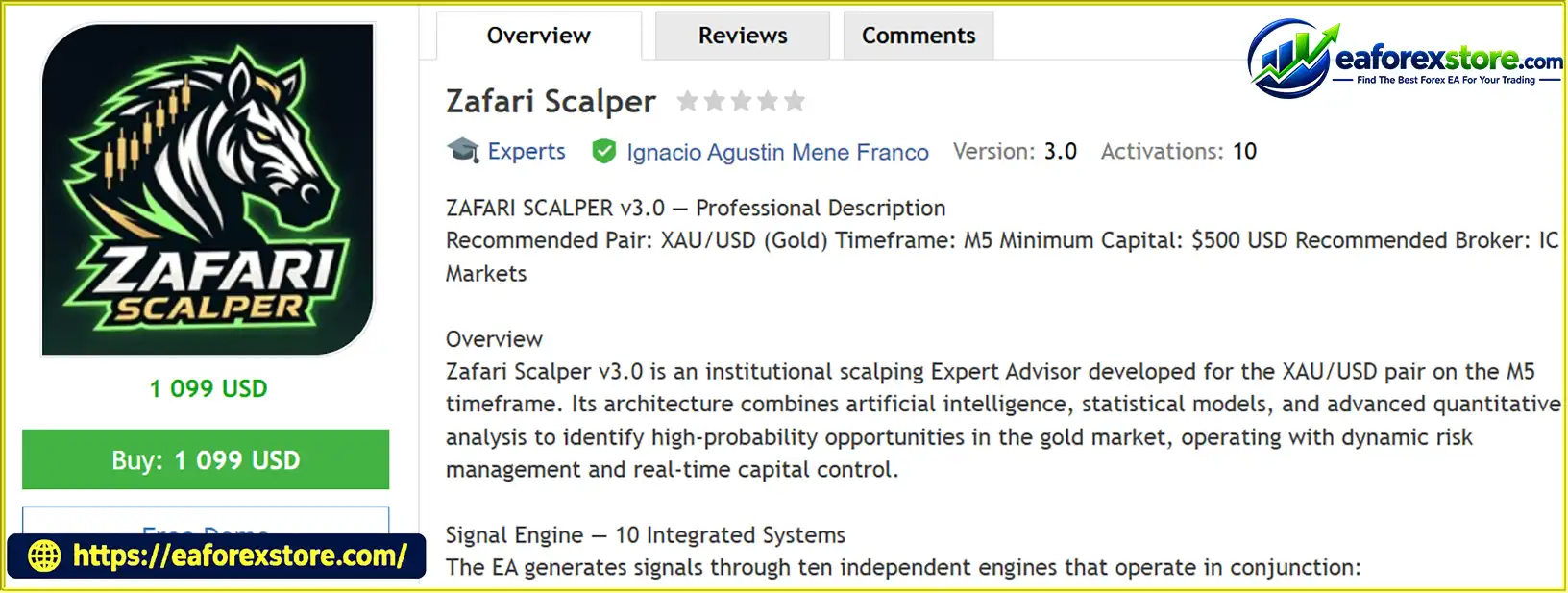
Zafari Scalper EA MT5 is an advanced scalping Expert Advisor designed for the MetaTrader 5 platform, specifically developed for trading gold (XAUUSD) on the M5 timeframe. According to its specifications, the EA combines artificial intelligence models, statistical classification, price-action recognition, technical indicators, and quantitative analysis to identify potential short-term trading opportunities.
Its signal architecture incorporates ten analytical systems, including a Bidirectional Long Short-Term Memory (BiLSTM) network, adaptive logistic regression, a Naive Bayes classifier, chart-pattern detection, dynamic support and resistance, Bollinger Bands, volatility analysis, and Fibonacci extension targets.
Beyond signal generation, Zafari Scalper EA MT5 integrates configurable position sizing and account-level risk controls. These include daily loss limits, maximum open positions, total-volume restrictions, margin safeguards, trailing stops, and automatic break-even functionality. A real-time dashboard displays the status of the analytical engines and important account metrics.
The EA also offers Turbo Mode, which is enabled by default according to the supplied specifications. This mode extends the signal lookback and applies a 1.5x lot-size multiplier, potentially increasing trading frequency and exposure.
Zafari Scalper EA MT5 may interest traders seeking an automated, multi-model approach to gold scalping. However, the complexity of its analytical architecture does not independently establish predictive accuracy or profitability. Traders should verify its behavior through realistic backtesting and demo-account testing before considering live deployment.
About the Developer
- Author: Ignacio Agustin Mene Franco
- Experience: Over 3 years of experience on MQL5.
- Notable Products: Zafari Scalper EA MT5, Neural Ma AI EA MT5, Trader Gold EA MT5, Vwap Scalper XAU EA MT5, Alligator Gold Cyber EA MT5, Merket Structure Pro EA MT5, Harmonic Pro AI EA MT5, Volumen Scalper GOLD EA MT5, Storm Trader EA MT5, Ichimoku Scalper Gold EA MT4, Level Hard Xauusd, Danesha Xauusd, Power Fusion Xauusd, Level Slow Xauusd EA MT4 and other advisors.
- Flagship Product: Zafari Scalper EA MT5 is rated as the best performing product of the year.
> Delivery time 24h-48h after payment.
>>> Refund if not delivered.
>>> You will receive the latest version without any limitations (ID+Time).Reviewed by Jason Stap <<<
Key Features of Zafari Scalper EA MT5
Ten Integrated Signal Engines
Zafari Scalper EA MT5 combines ten analytical components designed to evaluate different aspects of the gold market.
Artificial Intelligence and Statistical Models
- BiLSTM Neural Network: Processes sequences of price data in both forward and backward directions to identify potential temporal relationships. The supplied specifications describe a 30-candle input window and 16 hidden units.
- Adaptive Logistic Regression: Classifies market conditions into bullish, neutral, and bearish categories. It reportedly updates every five candles using online learning and eight features derived from recent price action.
- Naive Bayes Classifier: Estimates probabilities using candlestick patterns, London and New York trading-session information, and H1 trend confirmation.
Structural Market Analysis
- Chart Pattern Recognition: Identifies patterns such as Head and Shoulders, Inverse Head and Shoulders, Double Top, and Double Bottom. The system reportedly evaluates neckline levels and projected price targets.
- Dynamic Support and Resistance: Detects up to ten potential support and resistance levels using pivot analysis, configurable tolerance, and a minimum of two touches. It can evaluate potential bounce or breakout opportunities.
- Price Action Recognition: Detects selected candlestick formations, including Harami, Tweezer Top, Tweezer Bottom, and Marubozu, with filters for candle-body size and pip tolerance.
Quantitative and Volatility Analysis
- Bollinger Bands: Uses the supplied 20-period and 2.0-standard-deviation configuration to identify potential upper-band or lower-band bounce opportunities, subject to candle-close confirmation.
- Harmonic Volatility Pattern (HVP): Analyzes ATR-based volatility compression and expansion cycles. According to the specifications, it focuses on post-compression expansion conditions and applies a 1.3x confidence multiplier.
- Fibonacci Extension Targets: Calculates potential take-profit levels at 127.2%, 141.4%, and 161.8% of a previous swing.
- Volatility Quantile Filter: Classifies volatility into four quartiles, Q1 through Q4, and reportedly permits trading only in Q2 and Q3 to avoid unusually quiet or extremely volatile conditions.
These components are intended to provide complementary perspectives on market behavior. Their effectiveness depends on the quality of the data, the implementation of each model, the signal-combination rules, and how the system performs under changing market conditions.
Hierarchical Risk Parity (HRP)
The supplied design describes a Hierarchical Risk Parity mechanism that allocates risk among three primary signal components: BiLSTM, logistic regression, and support and resistance analysis.
The purpose of this approach is to account for relationships between the signals and reduce excessive concentration in highly correlated components. In principle, allocating risk according to correlation structure may help diversify the system's analytical inputs.
However, the practical benefit depends on how correlations are calculated, how frequently the allocation is updated, and whether the underlying signals remain reliable in live markets.
Continuous Kelly-Based Position Sizing
Zafari Scalper EA MT5 also describes a Hamilton-Jacobi-Bellman (HJB) framework combined with a risk-adjusted Kelly Criterion.
According to the supplied specifications, the calculation considers estimated market drift, historical symbol volatility, and a risk-aversion parameter of gamma = 2.0. The resulting multiplier adjusts the configured base risk between 0.2x and 2.0x.
This mechanism is intended to adapt exposure to changing market conditions. Nevertheless, Kelly-based sizing is sensitive to the accuracy of estimated probabilities and expected returns. Incorrect estimates can lead to excessive position sizes, so users should independently verify the calculation and apply conservative risk limits.
Active Risk Management
The EA includes several configurable account and trade-management restrictions:
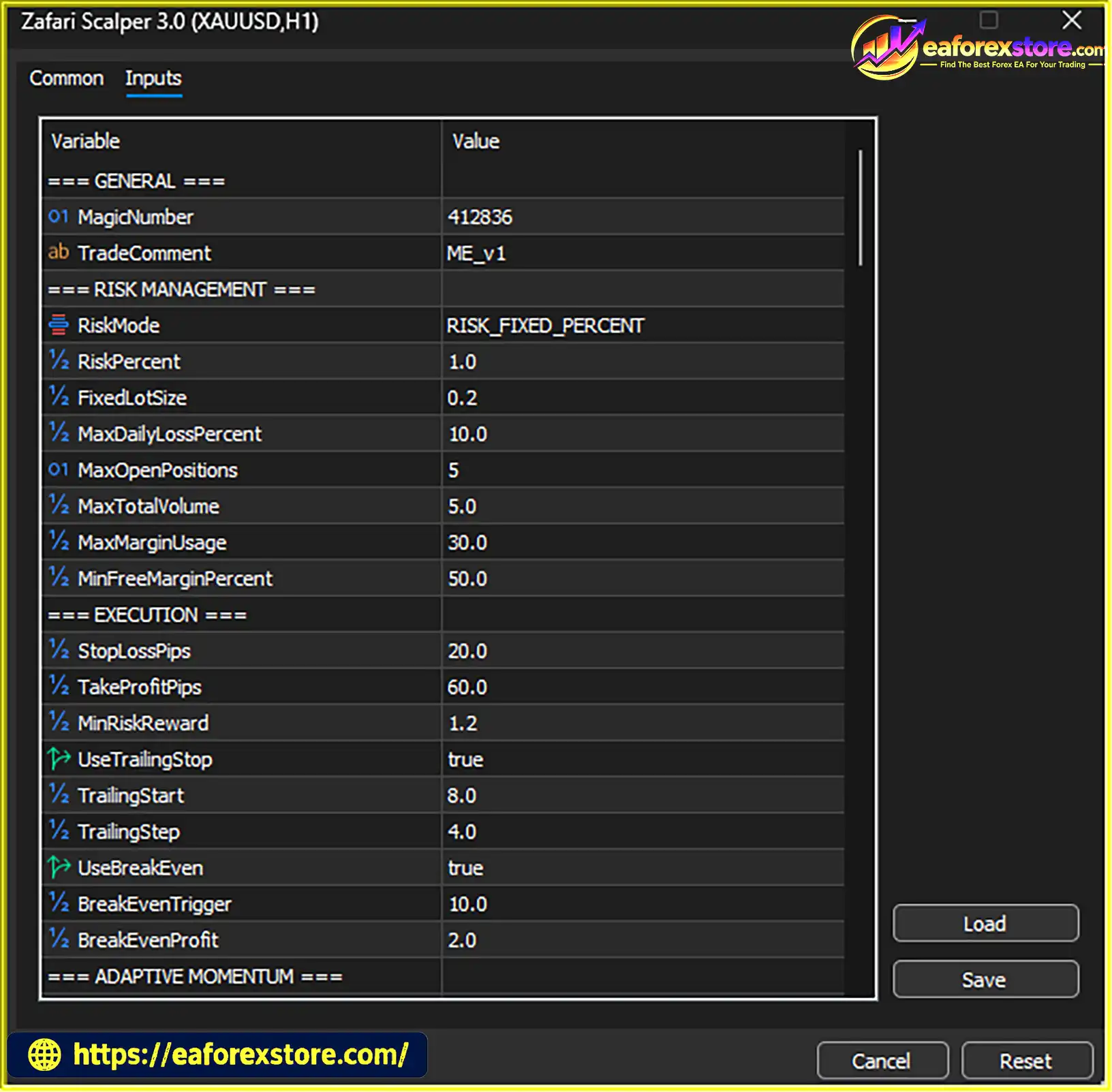
- Maximum daily loss: 10% of account balance by default, according to the supplied specifications.
- Maximum simultaneous positions: Five open positions.
- Maximum total volume: Five lots.
- Margin usage limit: 30%.
- Minimum free margin: 50%.
- Maximum spread filter: 50 pips.
- Trailing stop: Activates from eight pips of profit.
- Break-even: Configured to activate at ten pips of profit.
These settings are designed to limit exposure and manage open trades. Their actual effectiveness depends on implementation details, broker execution, and the definitions used for daily loss, margin usage, free margin, and pip distance.
The default daily-loss limit of 10% is relatively high for a conservative risk approach. Traders should consider whether a lower threshold is more appropriate for their account and tolerance for losses.
Turbo Mode
Turbo Mode is reportedly enabled by default. It extends the signal lookback and applies a 1.5x multiplier to lot size, potentially increasing trading frequency and position exposure.
Although this mode may make the EA more responsive to selected opportunities, it can also increase drawdown and accelerate losses during unfavorable market conditions. Traders should test Turbo Mode separately from standard settings and avoid assuming that a higher trading frequency produces better returns.
Flexible Risk Modes
The EA offers three position-sizing approaches:
- Fixed Lot Size: Uses a predefined trading volume.
- Percentage of Balance: Calculates exposure based on a selected percentage of account balance.
- Dynamic Equity Percentage: Adjusts exposure according to account equity.
These options allow traders to select a money-management approach suited to their account size and trading objectives. Regardless of the selected mode, position size should be evaluated alongside stop-loss distance, margin requirements, and maximum account exposure.
Trading Session Filter
An optional session filter allows users to restrict trading to selected times of day. This can help traders test the system during specific gold-market sessions and avoid periods with historically unfavorable spreads or liquidity.
Session restrictions do not eliminate the risk of news-driven volatility. Gold can experience sharp price movements during major economic announcements and changes in market sentiment.
Real-Time Monitoring Dashboard
Zafari Scalper EA MT5 includes a two-column dashboard that reportedly displays:
- Status of the AI and analytical engines.
- Current active signal.
- Signal-confidence level.
- Daily profit and loss.
- Account equity.
- Number of open positions.
- Total trading volume.
- Current spread.
- Accumulated daily drawdown.
The dashboard is intended to make the EA's operational status and account exposure easier to monitor. Displayed confidence values should not automatically be interpreted as verified probabilities of profitable trades unless their calibration and historical accuracy have been independently demonstrated.
How Does Zafari Scalper EA MT5 Work?
Zafari Scalper EA MT5 follows a multi-stage process that combines market analysis, signal evaluation, position sizing, and automated trade management.
Step 1: Monitor XAUUSD on the M5 Timeframe
The EA analyzes gold price data on the five-minute chart. Its analytical components examine price sequences, trend context, candlestick patterns, support and resistance, and volatility conditions.
Step 2: Generate Analytical Signals
The ten integrated engines evaluate different market characteristics. The AI and statistical models classify directional conditions, while structural and quantitative tools identify potential entry areas, price patterns, and volatility changes.
Step 3: Filter Market Conditions
The volatility quantile filter reportedly restricts entries to Q2 and Q3 conditions. Other components can evaluate candle-close confirmation, H1 trend direction, and trading-session context.
The exact rules used to combine conflicting signals should be verified in the EA's documentation or through controlled testing.
Step 4: Calculate Position Size
The selected money-management mode determines the initial exposure. The described HRP and Kelly-based mechanisms may then influence risk allocation and position size, subject to the configured multiplier range and account-level limits.
Step 5: Manage Open Positions
After a trade is opened, the EA can manage it through its configured stop-loss and take-profit logic, trailing stops, and break-even rules. Fibonacci extensions are among the specified methods for calculating potential take-profit targets.
Step 6: Monitor Account Risk
The EA tracks metrics such as daily profit and loss, open positions, total volume, spread, and margin conditions. Configured restrictions are intended to limit additional exposure when specified thresholds are reached.
Step 7: Display System Status
The dashboard provides an overview of the active signal, analytical-engine status, and important account metrics so that traders can review the system's activity.
Although the EA automates these stages, traders should verify the actual entry, exit, and emergency-stop behavior before using it on a live account.
Why Choose Zafari Scalper EA MT5?
Zafari Scalper EA MT5 may appeal to traders who want to evaluate an automated gold-scalping strategy built around multiple analytical methods rather than a single technical indicator.
Multi-Model Market Analysis: The ten-engine architecture combines AI-based classification, price-action analysis, chart patterns, support and resistance, and volatility filters.
Gold-Specific Design: The EA is configured for XAUUSD on M5, focusing on short-term opportunities in the gold market.
Adaptive Risk Framework: HRP and Kelly-based position sizing are designed to adjust exposure according to signal relationships and estimated market conditions.
Configurable Risk Restrictions: Daily-loss limits, position caps, volume restrictions, and margin controls provide several mechanisms for managing account exposure.
Automated Trade Management: Trailing stops and break-even functionality can help manage open positions according to predefined rules.
Session-Based Trading: The optional session filter provides flexibility when evaluating the EA during different periods of gold-market activity.
Real-Time Dashboard: The monitoring panel makes important operational and account metrics visible without requiring traders to inspect every parameter individually.
Flexible Position Sizing: Fixed lots, balance-based sizing, and dynamic equity-based sizing support different account-management preferences.
These features may justify further evaluation, but the number of models and risk controls should not be treated as evidence of superior performance. Independent testing remains necessary to establish whether the system provides a practical advantage.
Zafari Scalper EA MT5 Backtest Results
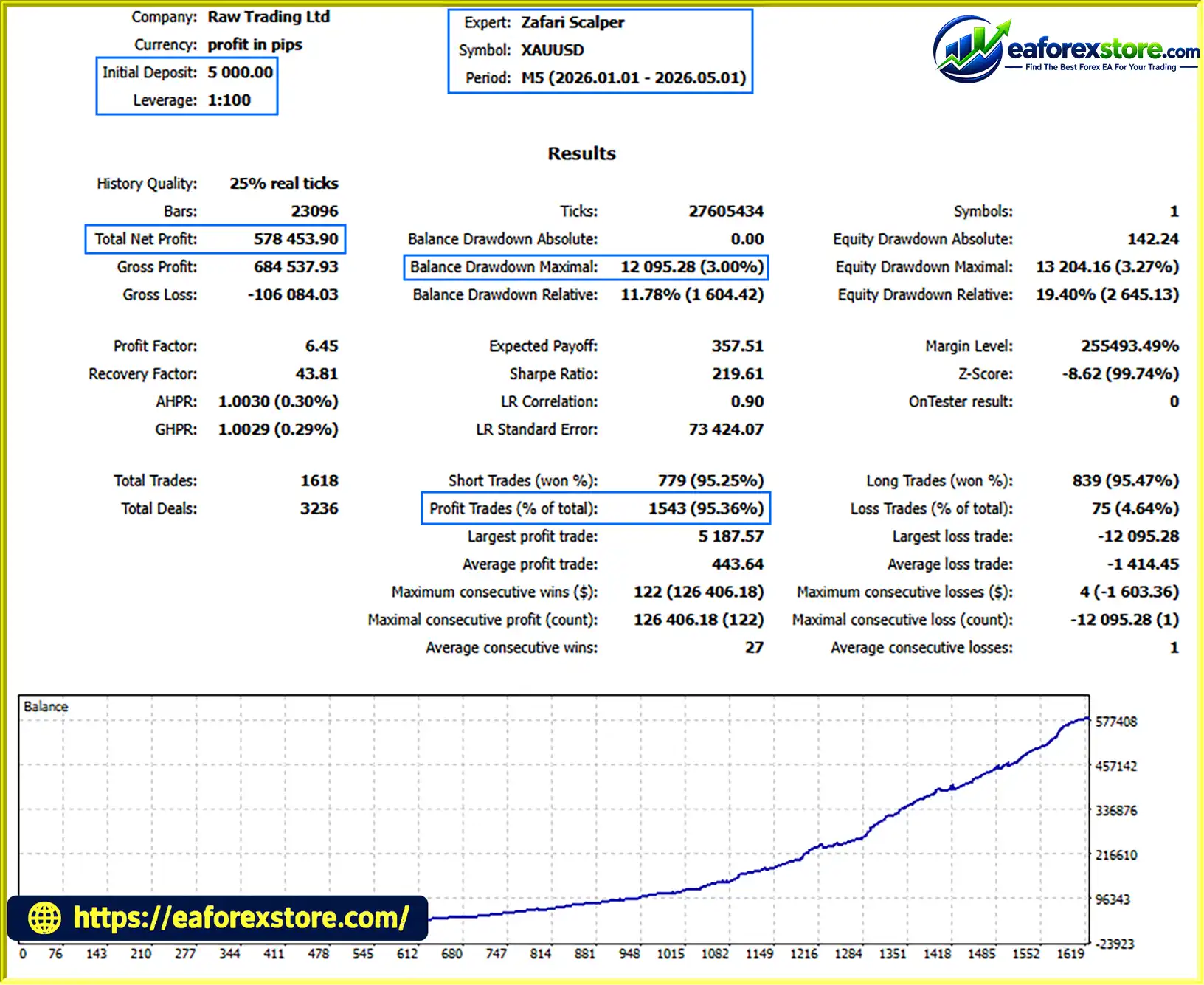
🔺XAUUSD (Gold) – 4 Months
- Initial Deposit: $5.000
- Total Net Profit: $578.453.90
- Win Rate (% of total): 95.36%
- Maximum Drawdown: 3.00%
Performance and Risk Management
Zafari Scalper EA MT5 is designed specifically for gold scalping on the M5 timeframe. Gold can experience rapid price changes, spread fluctuations, and sudden volatility increases, making execution quality and position sizing especially important.
Understanding the Risk Profile
The EA combines several models and risk-management mechanisms, but each introduces potential limitations.
- Model uncertainty: AI and statistical models may fail when market behavior differs from their training or calibration data.
- Signal disagreement: Different engines may produce conflicting assessments of market direction.
- Volatility changes: A volatility filter can exclude some market conditions, but it cannot reliably predict every sudden price shock.
- Dynamic position sizing: Kelly-based sizing may increase exposure when estimates suggest favorable conditions, but inaccurate estimates can produce excessive risk.
- Turbo Mode: The 1.5x lot multiplier can amplify both gains and losses.
- Multiple positions: Allowing up to five simultaneous positions may increase aggregate exposure if trades move against the account together.
- Gold execution costs: Spreads, slippage, commissions, and rapid price changes can materially affect short-term strategies.
Recommended Risk-Management Practices
For a more disciplined evaluation, traders should consider the following:
- Begin with conservative settings and evaluate standard mode before enabling Turbo Mode.
- Test fixed-lot and percentage-based sizing separately to understand the effect on drawdown.
- Verify how the EA calculates daily losses and whether the daily limit stops new entries, closes existing positions, or performs both actions.
- Confirm the exact behavior of the maximum-volume, margin, free-margin, and maximum-position restrictions.
- Test trailing-stop and break-even settings with the broker's actual XAUUSD contract specifications.
- Include realistic spreads, commissions, swaps, and slippage in backtests.
- Test across trending, ranging, and high-volatility gold-market periods.
- Conduct forward testing on a demo account before considering live trading.
- Monitor maximum equity drawdown, consecutive losses, total exposure, and margin usage—not just the win rate.
- Use only capital that you can afford to lose.
A daily-loss setting of 10% does not necessarily mean the account cannot lose more than 10% in a day. Gaps, slippage, execution failures, and the precise behavior of the EA's protective logic may affect the final result.
Weaknesses and Risk Warnings
Despite its extensive analytical architecture, Zafari Scalper EA MT5 has several limitations that potential users should understand.
No Verified Performance Figures Provided: The supplied description does not include independently verifiable live-account results, a detailed backtest report, or a documented maximum historical drawdown. Profitability should not be assumed without reliable evidence.
Complexity Does Not Guarantee Accuracy: Combining neural networks, statistical classifiers, technical indicators, and pattern recognition does not automatically improve prediction quality. Some engines may provide overlapping or unreliable signals.
Risk of Overfitting: Models and filters can appear effective on historical data but perform poorly on unseen market conditions. Robust testing should include out-of-sample data and forward testing.
Gold Market Volatility: XAUUSD can move sharply during economic announcements, geopolitical events, and changes in interest-rate expectations. Stop-loss execution may differ from the requested level.
High Default Daily-Loss Threshold: A 10% daily-loss limit can permit substantial losses before intervention, depending on how the limit is implemented. More conservative thresholds may be appropriate for risk-sensitive traders.
Turbo Mode Exposure: The default 1.5x lot multiplier can increase drawdown, particularly when the signal models perform poorly or several positions are open simultaneously.
Kelly-Based Sizing Risk: Position-sizing methods based on expected returns can become unreliable when the estimated edge or volatility changes. Aggressive sizing should be avoided until the calculations have been validated.
Broker Dependency: Spreads, commissions, contract specifications, minimum stop distances, and execution quality can vary between brokers. Settings that work in one environment may not work in another.
Pip and Point Differences: Gold symbols can use different decimal precision and contract specifications. The EA's pip-based spread, stop-loss, trailing-stop, and break-even settings must be checked against the broker's actual symbol configuration.
No Guaranteed Returns: Neither AI-based analysis nor automated risk management guarantees profitable trades. Losses may occur even when all systems operate as intended.
Before purchasing or deploying the EA, users should confirm that the advertised functions are present in the delivered version and that the risk controls behave as documented.
Pros and Cons
Pros
- Designed specifically for XAUUSD scalping on the M5 timeframe.
- Combines ten analytical engines covering AI, statistics, price action, chart patterns, and volatility.
- Includes dynamic support and resistance analysis.
- Offers volatility filtering and Fibonacci-based profit targets.
- Describes HRP and Kelly-based position-sizing mechanisms.
- Provides fixed-lot, balance-based, and equity-based risk modes.
- Includes daily-loss, position-count, volume, and margin restrictions.
- Supports automatic trailing stops and break-even management.
- Offers an optional trading-session filter.
- Includes a real-time dashboard for monitoring signals and account metrics.
Cons
- No independently verified performance results are included in the supplied specifications.
- The complexity of the system can make its behavior difficult to evaluate.
- AI and statistical models may lose effectiveness when market conditions change.
- Turbo Mode can increase exposure and drawdown.
- A 10% daily-loss threshold may be too aggressive for conservative traders.
- Gold scalping is sensitive to spreads, slippage, and execution quality.
- Multiple open positions can increase aggregate risk.
- Kelly-based position sizing depends on the accuracy of its estimates.
- Broker-specific symbol settings may require careful adjustment.
- Live trading performance cannot be guaranteed.
How to Install Zafari Scalper EA MT5
Follow these general steps to install and test the Expert Advisor in MetaTrader 5.
Step 1: Obtain the EA File
Download Zafari Scalper EA MT5 from the developer or a trusted source. Confirm that the file is compatible with MetaTrader 5.
Step 2: Open the MT5 Data Folder
Launch MetaTrader 5 and select File → Open Data Folder.
Step 3: Install the Expert Advisor
Open the MQL5 directory, then the Experts folder. Copy the EA file into that directory.
Step 4: Refresh the Navigator
Return to MT5 and refresh the Expert Advisors list in the Navigator panel. Restart the platform if necessary.
Step 5: Open the Correct Chart
Open the broker's XAUUSD chart and set the timeframe to M5. Confirm the broker's gold symbol name, as some brokers use suffixes or alternative naming conventions.
Step 6: Attach the EA
Drag Zafari Scalper EA MT5 onto the chart and review its available inputs. Confirm the position-sizing mode, risk limits, spread filter, Turbo Mode, session settings, and trade-management parameters.
Step 7: Enable Automated Trading
Enable the platform's Algo Trading function and grant the required permissions. Check the Experts and Journal tabs for initialization errors or order-execution messages.
Step 8: Verify the Risk Controls
Confirm how the EA calculates lot size, daily drawdown, margin usage, free margin, and total volume. Check that the trailing stop, break-even rules, and maximum-position restriction behave as expected.
Step 9: Backtest and Forward-Test
Use realistic historical data and transaction costs in the MT5 Strategy Tester. Then forward-test the EA on a demo account to evaluate its behavior under live market conditions.
The installation process may vary depending on the file format and the developer's instructions. Do not move directly to live trading without validating the EA's operation.
Technical Requirements
| Parameter | Specification |
|---|---|
| Trading platform | MetaTrader 5 |
| Expert Advisor | Zafari Scalper EA MT5 |
| Primary instrument | XAUUSD (Gold) |
| Recommended timeframe | M5 |
| Minimum capital stated by the provider | $500 USD |
| Recommended broker | IC Markets, according to the supplied description |
| Suggested account type | ECN / Raw Spread |
| Minimum leverage stated | 1:100 |
These are the supplied product specifications, not independently verified requirements or guarantees of suitability. A $500 balance may be insufficient for certain lot sizes or risk settings, depending on the broker's contract specifications, margin requirements, and the EA's position-sizing behavior.
Before choosing a broker, verify that its gold trading conditions, commissions, leverage, and execution rules are compatible with the EA. The broker mentioned above should be treated as a recommendation in the supplied description, not an endorsement or assurance of better performance.
What’s Included in the Download Package?
- Experts: Zafari Scalper.ex5
>>> Join VIP Membership Now <<<
Final Thoughts
Zafari Scalper EA MT5 is presented as an AI-powered gold scalping system that combines ten analytical engines with dynamic position sizing, volatility filtering, and automated trade management. Its focus on XAUUSD M5, together with configurable risk controls and a monitoring dashboard, may make it worth evaluating for traders interested in multi-model automated trading.
Its most important consideration is not the number of analytical components, but whether those components produce a measurable and repeatable advantage after trading costs. The default Turbo Mode, Kelly-based sizing, multiple-position allowance, and 10% daily-loss threshold deserve particular attention during testing.
For a prudent evaluation, start with conservative settings, verify the EA's protective mechanisms, and test it on a demo account using realistic spreads and execution conditions. Review drawdown, risk-adjusted returns, and performance across different gold-market environments before considering real capital.
Risk Disclaimer: Zafari Scalper EA MT5 is an automated trading tool, not a guaranteed source of income. Trading gold and CFDs involves substantial financial risk, and you may lose some or all of your capital. Historical tests and AI-generated confidence scores do not guarantee future results. Always perform independent testing and use risk settings appropriate to your financial circumstances.